How AI Investment Trends Are Creating New Business Opportunities in 2026
ALT: AI investment trends creating new business opportunities and economic growth in 2026
For educational purposes only. Not investment advice.
- AI investment is not confined to the technology sector — it generates business opportunities across healthcare, logistics, energy, compliance, construction, and professional services, among other areas.
- The most accessible opportunities often lie in secondary and tertiary effects of AI deployment: the services, infrastructure, and expertise that AI systems require to function in real-world business environments.
- Regulatory activity is a leading indicator of AI adoption maturity — when governments begin drafting compliance frameworks for AI, business opportunities in governance and consulting tend to follow.
- A common misconception is that AI only creates opportunities for programmers and engineers. In practice, domain expertise combined with AI tool literacy is often a more differentiated and less saturated value proposition.
- Understanding AI investment trends as an economic literacy exercise — rather than an investment signal — equips everyday readers to interpret financial headlines more accurately and recognize how these trends connect to their own professional and economic lives.
- Your next step is straightforward: keep reading broadly about AI economic trends, look for the supply-chain and infrastructure angles behind major announcements, and connect AI coverage to adjacent economic stories about energy, labor, and policy.
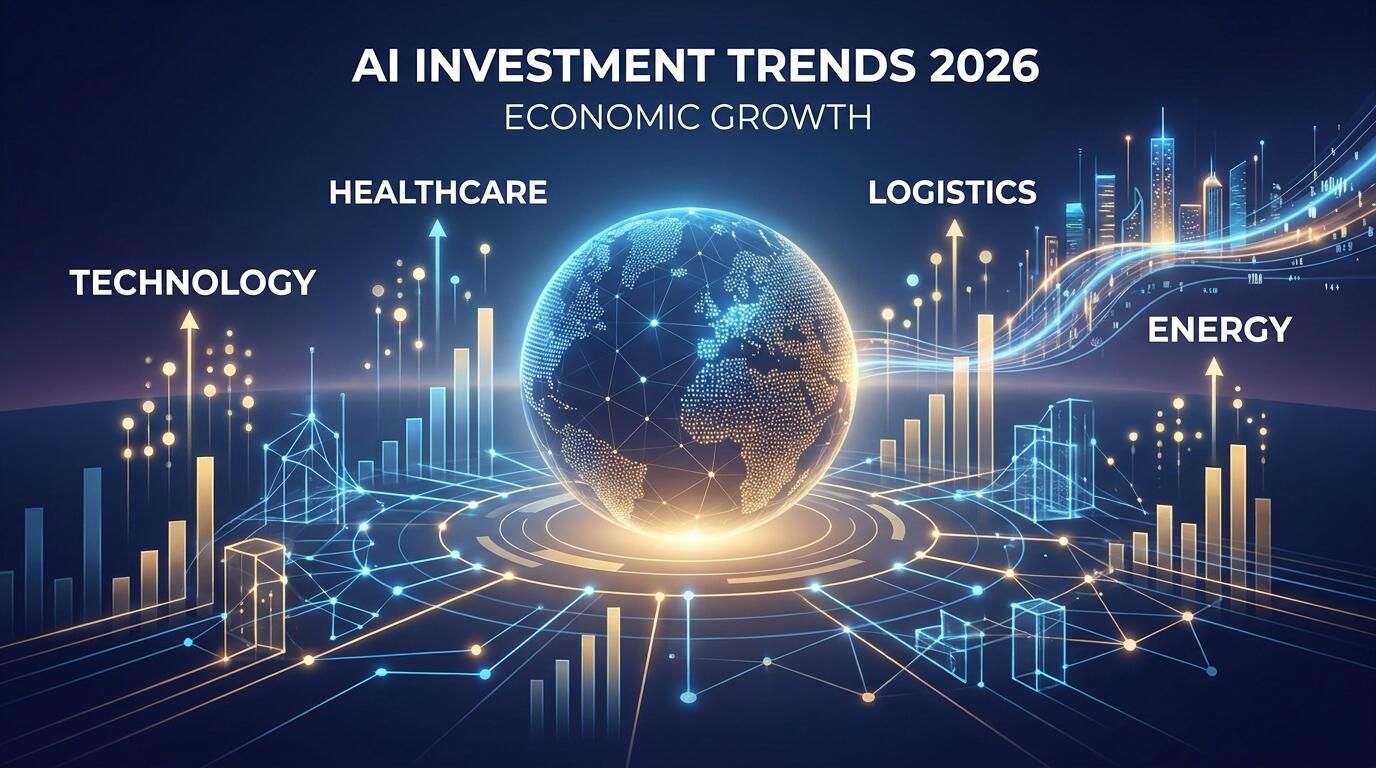
ALT: AI investment trends creating new business opportunities and economic growth in 2026
What You'll Learn: How AI Investment Trends Are Reshaping Business Opportunities in 2026
Imagine you work at a mid-sized logistics company and you keep hearing that artificial intelligence is transforming entire industries — but you're not sure what that actually means for your paycheck, your employer, or the economy around you. Or perhaps you're a recent graduate scanning the job market and noticing that every employer seems to want someone who "understands AI," yet nobody explains what that really involves. These scenarios are far more common than most financial headlines let on.
This guide is designed to help everyday readers — not economists or tech insiders — understand how the current wave of AI investment is generating real, tangible business opportunities across multiple sectors in 2026. By the end, you'll have a clearer picture of what's happening, why it matters to your daily life, and how to think about these changes without needing a finance degree.
Before You Start: What You Should Know Going In
Understanding AI investment trends doesn't require a background in technology or economics. But a few foundational concepts will help you follow along more clearly and get the most out of this guide.
First, it helps to understand what "AI investment" actually means in this context. Artificial intelligence investment refers to the money that governments, corporations, and financial institutions are directing toward AI research, infrastructure, software development, and workforce training. This is not about buying stocks — it's about understanding where large sums of money are flowing and what that flow creates in the broader economy.
Second, it's useful to know that when major investment trends emerge, they tend to ripple outward. A company that builds AI data centers needs construction workers, electricians, cooling systems, and real estate. A hospital that adopts AI diagnostic tools needs trainers, privacy compliance officers, and maintenance staff. These secondary effects — sometimes called "spillover effects" — are often where the most accessible business opportunities emerge for everyday entrepreneurs and workers.
Third, keep in mind that this article is purely educational. Nothing here constitutes financial advice or a recommendation to invest in any company, fund, or asset class.
Checklist before starting:
A basic understanding that "investment" means money directed toward building or developing something
Familiarity with the idea that AI stands for artificial intelligence — technology designed to perform tasks that typically require human thinking
Willingness to think about economic trends at a broad, conceptual level rather than a stock-by-stock level
No prior experience in finance, economics, or technology is required
Step 1: Understand the Scale of AI Investment Flowing Into the Economy
The first step to grasping any economic trend is understanding its magnitude — and the current wave of AI investment is historically significant. Major technology companies, national governments, and institutional investors are committing enormous resources to artificial intelligence infrastructure, research, and deployment. According to reporting tracked by the International Monetary Fund, AI-related capital expenditure has become one of the most significant drivers of private sector investment in developed economies heading into the latter half of this decade.
What does that mean in plain language? It means that a large and growing share of the money businesses spend on building new things is now going toward AI-related projects — data centers, computing chips, software platforms, and the people who operate them. This spending creates economic activity that extends far beyond the technology sector itself.
Tip: Think of AI investment the way you might think of a major highway construction project. The highway itself is the goal, but the real economic activity involves cement suppliers, equipment rentals, food vendors near work sites, and hotels for workers — all businesses that benefit indirectly.
Step 2: Identify the Sectors Where AI Investment Is Generating New Demand
Once you understand the scale of AI investment, the next step is recognizing where that investment is actually landing — because not every industry is affected equally, and the opportunities are distributed unevenly.
In our work explaining financial and economic news at Vega Brief, a pattern we consistently see is that readers are surprised by how broad the AI opportunity landscape really is. Most people assume AI only creates opportunities for software engineers or data scientists. In reality, the sectors experiencing the most significant transformation in 2026 include healthcare, logistics and supply chain management, financial services, agriculture, education technology, and energy management.
Healthcare is a particularly active area. Hospitals and clinics are integrating AI-assisted diagnostic tools that help physicians review medical images, flag potential diagnoses, and manage patient records more efficiently. This creates demand not just for the AI systems themselves, but for the trainers, compliance specialists, and integration consultants who make those systems work within existing institutional frameworks.
In logistics and supply chain management, AI-powered routing and inventory systems are helping companies reduce waste and improve delivery times. This is generating demand for workers who can operate and troubleshoot these systems, as well as for smaller regional firms that can offer specialized integration services to businesses that can't afford large-scale enterprise contracts.
Tip: When reading financial news about AI, ask yourself not just "which tech company benefits?" but "what does this company need to buy, hire, or build to make this work?" — that's where broader business opportunities appear.
Step 3: Recognize How AI Investment Is Affecting the Labor Market
Understanding AI's impact on employment is one of the most important — and most misunderstood — aspects of this economic moment. The headline-grabbing concern is job displacement: the fear that AI will eliminate roles across industries. That concern is real and deserves honest acknowledgment. But the fuller picture, which economic researchers at institutions like the Organisation for Economic Co-operation and Development (OECD) have been tracking, is more nuanced.
AI investment is simultaneously displacing certain types of repetitive, rule-based tasks and creating demand for new roles that didn't exist or were far smaller just a few years ago. The jobs being created tend to cluster around several categories: AI system oversight and quality control, data labeling and curation, ethics and compliance review, customer-facing AI integration, and technical support for AI-powered tools.
For workers and small business owners, the practical implication is that adaptability has measurable economic value right now. A pattern we consistently see when explaining economic headlines is that readers who understand this labor market shift early are better positioned to recognize training opportunities, pivot their services, or hire strategically — not because they've made investment decisions, but because they understand the economic landscape they're operating in.
The broader relationship between AI investment and global growth is one that economists are actively debating, and it's a story that extends well beyond any single company or sector.
Tip: Think about your own work. Are there repetitive, rules-based tasks you perform regularly? AI tools are most likely to affect those first. Meanwhile, skills involving judgment, client relationships, and contextual problem-solving are generally more durable.
Step 4: Explore the Business Opportunities That AI Infrastructure Demands Create
AI systems require physical infrastructure, and that infrastructure creates business opportunities that have nothing to do with software or algorithms. This is a step that many readers skip over — but it's arguably where some of the most accessible and concrete opportunities exist.
Data centers — the large facilities that house the computing hardware AI systems run on — require construction, ongoing maintenance, cooling systems, electrical work, and real estate. The rapid expansion of AI data center capacity across North America, Europe, and parts of Asia is generating sustained demand in all of these areas. Construction firms, commercial real estate developers, energy providers, and utilities companies are all seeing increased activity directly tied to AI infrastructure buildout.
Energy is particularly significant. AI computing is energy-intensive, and the growing demand for reliable, clean power to run AI systems is accelerating investment in energy infrastructure — including renewable energy projects, grid modernization efforts, and energy storage systems. This creates opportunities not just for large utilities, but for smaller regional contractors, equipment suppliers, and engineering consultants.
Tip: Follow the infrastructure angle when reading AI-related business news. Stories about new data center announcements, power grid investments, or chip manufacturing expansions often contain more information about near-term business opportunity than stories focused purely on software capabilities.
Step 5: Understand How Small and Mid-Sized Businesses Are Responding
Large technology companies and major financial institutions are the most visible participants in the AI investment wave, but small and mid-sized businesses are increasingly significant actors in this story — both as adopters of AI tools and as providers of specialized services.
A growing ecosystem of smaller firms has emerged to help larger businesses implement AI solutions without the disruption of building everything in-house. These firms offer services ranging from AI readiness assessments and data preparation to staff training and ongoing system audits. In many cases, they are operated by people with backgrounds in industries like healthcare administration, legal services, or retail — not necessarily technology — who have developed expertise in applying AI tools within specific professional contexts.
For entrepreneurs and small business owners, this suggests a practical opportunity: domain expertise plus AI tool proficiency can be a genuinely differentiated service offering. A retired nurse who understands clinical workflows and learns how to evaluate AI diagnostic tools is potentially more valuable to a regional hospital than a generalist technology consultant.
Tip: You don't need to understand how AI is built to create a business opportunity around it. Understanding how AI is used within a specific professional context is often more valuable and less saturated.
Step 6: Track the Policy and Regulatory Environment Shaping AI Business Opportunities
Business opportunities don't exist in a vacuum — they're shaped by government policy, and the regulatory environment around AI is evolving rapidly. In 2026, governments in major economies are actively developing frameworks to govern AI deployment, particularly in high-stakes areas like healthcare, financial services, hiring, and law enforcement.
The European Union has been among the most active regulators, with a comprehensive framework designed to classify AI systems by risk level and impose corresponding compliance requirements. In the United States, multiple federal agencies — including the Federal Trade Commission and the Department of Commerce — have issued guidance on AI transparency and accountability. These regulatory developments create demand for a new category of professional services: AI compliance consulting, regulatory monitoring, and ethics review.
For readers trying to understand what this means practically: regulation often creates business opportunity for those who understand the rules. Lawyers, compliance officers, accountants, and auditors who develop expertise in AI governance are entering a relatively early and growing market for their services.
Tip: Regulatory complexity tends to create a "knowledge gap" between organizations that must comply and the professionals who can help them do so. That gap is a business opportunity.
Step 7: Put It All Together — Build a Mental Map of the AI Opportunity Landscape
The final step is synthesis: taking the individual threads identified above and connecting them into a coherent picture you can use when reading financial news, thinking about your career, or evaluating your own business environment.
The AI investment wave is not a single event. It's an ongoing economic shift that is simultaneously building new infrastructure, creating new roles, generating demand for new services, and producing new regulatory requirements. Each of these threads touches everyday life — in the form of job market changes, business service demand, energy costs, and public policy debates.
Reading financial headlines about AI through this lens — rather than simply asking "will this make the stock market go up?" — provides a much richer and more actionable understanding of what's actually happening. That's precisely the kind of financial literacy that helps ordinary readers make sense of economic news without needing to become investors or economists.
Common Mistakes and Troubleshooting When Reading AI Investment News
Symptom — Likely Cause — How to Fix
Feeling confused by AI headlines that seem to contradict each other — Different stories focus on different layers of the AI economy (infrastructure, software, labor), which move at different speeds — Identify which layer the story is about before drawing conclusions
Assuming AI only creates opportunities for programmers and engineers — Mainstream coverage tends to focus on technology roles, underrepresenting adjacent sectors — Actively seek out reporting on logistics, healthcare, energy, and compliance — sectors where AI demand is equally significant
Believing AI will eliminate all jobs in a given sector — Displacement and creation often happen simultaneously within the same industry — Look for research from organizations like the OECD or World Economic Forum that tracks both job losses and job creation across sectors
Treating AI investment news as a signal to buy or sell assets — Financial news about industry trends does not translate directly into predictable short-term market movements — Use AI trend coverage to understand the economy, not to time investments
Getting overwhelmed by technical jargon in AI reporting — Technology journalism often assumes a level of prior knowledge that general readers don't have — Look for plain-language explainers from educational platforms before engaging with more technical sources
ALT: Diagram showing AI investment flowing into healthcare, logistics, energy, and compliance business sectors creating economic opportunities in 2026
Pro Tips for Getting More Value From AI Trend Coverage
Follow the money to the second-order effects. When a major technology company announces a large AI investment, the most interesting business story is often not about that company — it's about the suppliers, contractors, and service providers that announcement will benefit. Construction firms, cooling system manufacturers, and electrical engineering companies are often more directly affected than the software sector.
Treat regulatory developments as leading indicators. When governments begin drafting rules for a new technology, it signals that the technology is becoming commercially significant enough to require governance. Regulatory activity around AI in healthcare, financial services, and hiring is a reliable indicator that these sectors are entering a meaningful adoption phase — and that compliance-related business opportunities are emerging.
Distinguish between AI hype and AI deployment. A common misconception is that every headline about a new AI capability represents an immediate, large-scale economic shift. In reality, there is typically a significant gap between what AI systems can demonstrate in controlled settings and what is being deployed at scale in real business environments. Following deployment-focused reporting — rather than capability-focused announcements — gives a more accurate picture of where business opportunities are actually materializing.
Use primary sources when they're accessible. Reports published by organizations like the OECD, the International Monetary Fund, and national central banks tend to be more measured and evidence-based than commercial news coverage. Many of these reports are available to the public without a subscription.
Connect AI trends to adjacent economic stories. AI infrastructure investment intersects with energy policy, interest rate environments, and labor market dynamics in ways that enrich your understanding of each topic individually. For example, the surge in demand for data center power capacity is one reason energy infrastructure investment is growing even as interest rates remain elevated in many economies — a connection that Federal Reserve rate decisions and broader monetary policy discussions don't always make explicit.
Q1: How does AI investment create business opportunities for people who aren't in the technology industry?
AI investment creates demand across the entire supply chain of AI deployment — not just software development. When a hospital adopts an AI diagnostic tool, it needs compliance specialists, trainers, and process redesign consultants. When a company builds a data center, it needs construction workers, electricians, and facility managers. Business opportunities emerge wherever AI systems require human expertise to implement, operate, or regulate — and those roles span nearly every professional field.
Q2: Are the business opportunities created by AI investment accessible to small businesses, or only to large corporations?
Small businesses are active participants in the AI opportunity landscape, not just passive observers. A growing category of boutique consulting firms is helping larger organizations implement AI tools within specific industry contexts — healthcare, legal, logistics, retail — and many of these firms are founded and operated by people with deep domain expertise rather than technology backgrounds. The most accessible opportunities tend to involve specialized knowledge of how AI is used within a particular professional context, rather than knowledge of how AI is built.
Q3: How long is the current wave of AI investment expected to continue generating new business opportunities?
The current cycle of AI investment is not a short-term phenomenon. Major technology companies, institutional investors, and national governments have made multi-year capital commitments to AI infrastructure and deployment. Economic researchers, including those at the International Monetary Fund, describe the present period as an early-to-mid phase of a structural economic transition — meaning the business opportunities being generated now are likely to evolve rather than disappear over the coming years, though their specific character will shift as technology matures and regulatory frameworks solidify.
References
International Monetary Fund. "World Economic Outlook Reports."
https://www.imf.org/
Organisation for Economic Co-operation and Development (OECD). "Artificial Intelligence and Employment: Policy and Research."
https://www.oecd.org/
European Commission. "EU Artificial Intelligence Act and Regulatory Framework."
https://ec.europa.eu/
U.S. Department of Commerce. "Artificial Intelligence and National Economic Policy Guidance."
https://www.commerce.gov/
Note: Regulatory frameworks and economic research on AI are updated frequently; please check the latest official documents or consult qualified professional advisors for guidance specific to your circumstances.
For educational purposes only. Not investment advice. We do not recommend any stock, fund, broker or trading platform. Headlines are sourced from Google News · Business; every story links to the original publishers.