What a Central Bank Rate Pause Means for Borrowers This Quarter
ALT: Central bank rate pause explained for borrowers navigating loans and interest costs this quarter
For educational purposes only. Not investment advice.
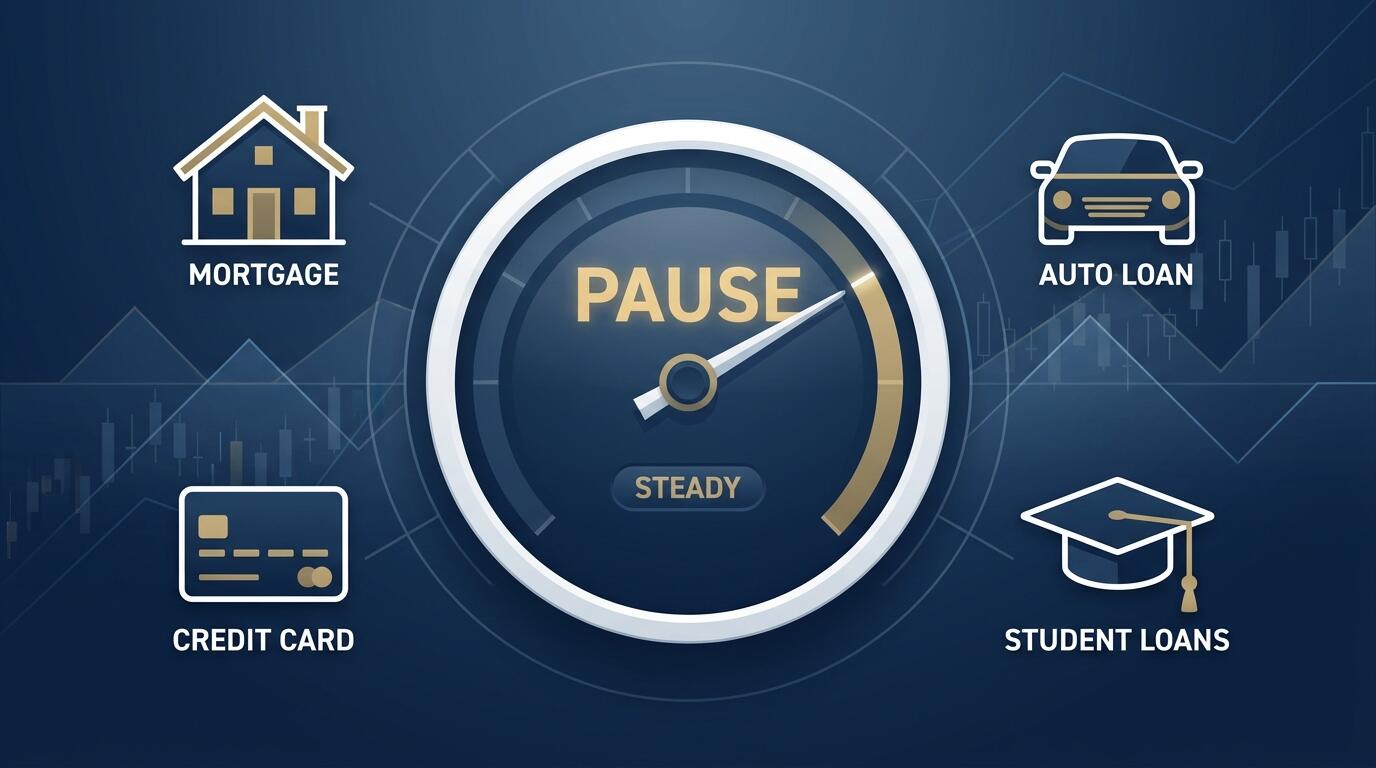
ALT: Central bank rate pause explained for borrowers navigating loans and interest costs this quarter
What a Rate Pause Actually Means — and Why Borrowers Should Pay Attention
A central bank rate pause is a decision by a country's central monetary authority — such as the Federal Reserve in the United States — to hold its benchmark interest rate steady at its current level rather than raising or lowering it. This might sound like a non-event, but in practice, a pause carries real consequences for anyone carrying a mortgage, managing credit card debt, planning to take out a student loan, or simply wondering whether now is the right time to refinance.
At Vega Brief, a pattern we consistently see is that the moment a central bank signals a pause, headlines flood financial media with technical language that leaves everyday readers more confused than informed. The words "data-dependent," "terminal rate," and "forward guidance" get thrown around without much explanation of what they mean for a household budget or a loan repayment schedule.
This article breaks down the practical effects of a rate pause on different types of borrowing. We have selected the most common borrowing categories that readers encounter in daily financial life — mortgages, auto loans, credit cards, student loans, home equity lines, personal loans, and business credit — and explain how a pause ripples through each one. The goal is not to tell you what to do with your money, but to help you understand the landscape so you can ask better questions and read the news with greater confidence.
Mortgages and the 30-Year Fixed Rate
A rate pause does not automatically lower your mortgage rate, but it can create the conditions for rates to stabilize or edge downward over time. Fixed mortgage rates are influenced by the yield on long-term government bonds, particularly the 10-year Treasury note, which is itself shaped by expectations about where the central bank's policy rate is headed. When the Federal Reserve signals that it is done raising rates — at least for now — bond markets often react by pricing in a more stable or declining rate environment, which can pull long-term mortgage rates slightly lower.
In our work interpreting monetary policy for general audiences, this is one of the most misunderstood dynamics we encounter. People assume a Fed pause means mortgage rates drop immediately. In reality, the transmission takes time and depends on what bond investors believe about future rate direction — not just what the Fed does today.
For readers curious about the deeper mechanics, how the Federal Reserve's current rate decisions affect your mortgage and savings is worth exploring as a companion piece.
Best for: Prospective homebuyers who have been waiting on the sidelines and want to understand whether borrowing conditions are shifting in their favor.
Watch out: Mortgage rates can remain elevated even during a pause if inflation expectations stay high, because bond investors demand a premium to compensate for the risk that inflation erodes the purchasing power of future interest payments.
Auto Loans and Dealer Financing
Auto loan rates are tied closely to shorter-term interest benchmarks, which move in tighter lockstep with the federal funds rate than long-term mortgage rates do. A rate pause, therefore, tends to freeze auto loan rates roughly where they are — neither climbing higher nor falling in any meaningful way until the central bank actually moves in one direction or another.
For someone weighing whether to purchase a vehicle now or wait, a pause period is effectively a period of relative predictability. What the rate pause will not do is undo the elevated cost of borrowing that accumulated during a prior rate-hiking cycle. If rates were raised significantly before the pause, auto loan costs are still high in absolute terms — the pause just stops them from getting worse.
Best for: Buyers who need a vehicle in the near term and want at least the assurance that rates are not likely to rise further in the coming months.
Watch out: The price of the vehicle itself, which is a separate variable from the interest rate, can offset any minor improvement in financing conditions.
Credit Card Debt and Variable-Rate Lines
Credit card interest rates are almost entirely variable and track the prime rate, which moves directly with the federal funds rate. A rate pause means the prime rate stays where it is, which in turn means credit card annual percentage rates (APRs) stop climbing. However, balances that accumulated during the hiking cycle are still subject to the higher rates already in place.
This is one of the areas where a pause is often most misread. Cardholders sometimes interpret a pause as a form of relief, but if the central bank has already raised rates substantially over a prior period, the cost of carrying a balance is already near a recent high. Stabilization is not reduction. The Federal Reserve's own communications, including the Federal Open Market Committee (FOMC) statements released after each meeting, make clear that a pause is not a pivot to lower rates.
Best for: People with variable-rate credit card debt who want to understand whether their minimum monthly interest charges are likely to increase further this quarter.
Watch out: Even in a pause, credit card companies retain the ability to adjust rates for other reasons, including changes to your credit profile or revisions to card agreement terms.
Student Loans — Federal and Private
Federal student loans in the United States have fixed interest rates set annually by Congress, tied to the yield on 10-year Treasury notes at a specific point in the calendar year. A central bank rate pause mid-year does not change the rate on existing federal loans — those are locked in at origination. However, for students taking out new loans in an upcoming academic year, a pause that contributes to lower Treasury yields could result in modestly lower rates on newly issued federal loans.
Private student loans, by contrast, can carry either fixed or variable rates. Variable-rate private loans behave similarly to credit cards: the pause stops the rate from climbing but does not reverse the increases already applied.
Best for: Current students or recent graduates with variable-rate private loans who want to understand whether their interest burden is likely to grow further in the short term.
Watch out: Refinancing a federal student loan into a private loan to chase a lower rate means giving up federal protections, including income-driven repayment options and potential forgiveness programs. A pause period is not a reason to make that trade hastily.
Home Equity Lines of Credit (HELOCs)
A home equity line of credit, commonly called a HELOC, is a revolving credit product secured against a borrower's home equity, and it carries a variable interest rate that adjusts with the prime rate. Because the prime rate moves with the federal funds rate, a HELOC rate rises and falls in close alignment with central bank decisions.
During a rate pause, HELOC rates stabilize. For homeowners who drew on a HELOC during a period of rising rates, the pause offers a window of payment predictability — monthly interest charges will not increase further as long as the central bank holds. This predictability can be useful for household cash flow planning, even if the underlying rate remains high by historical standards.
Best for: Homeowners actively drawing on or repaying a HELOC who want to budget their monthly interest costs with greater certainty.
Watch out: A HELOC is secured by your home. Predictable payments during a pause should not create a false sense of comfort about the inherent risk of pledging home equity as collateral.
Personal Loans — Fixed and Variable
Personal loans — unsecured loans typically used for debt consolidation, home improvement, or major expenses — come in both fixed- and variable-rate forms. Fixed-rate personal loans, once originated, are unaffected by subsequent central bank decisions. Variable-rate personal loans, like HELOCs and credit cards, benefit from a pause in the sense that rates stop rising.
In our experience explaining monetary policy to general audiences, personal loans are where borrowers often make timing decisions based on incomplete information. A pause signals rate stability, not rate decline. Locking in a fixed-rate personal loan during a pause can make sense if the goal is to trade the uncertainty of future rate movement for the predictability of a set monthly payment — but that is a practical consideration, not a financial recommendation.
Best for: Borrowers considering debt consolidation who want to understand whether the current rate environment is likely to shift significantly in the near term.
Watch out: The rate a lender offers you on a personal loan depends heavily on your individual credit profile, not just on the broader interest rate environment. The federal funds rate sets a floor, not your personal ceiling.
Business Credit Lines and Small Business Loans
Small businesses that rely on revolving credit lines or variable-rate commercial loans feel the effects of a rate pause in much the same way as individual borrowers with HELOCs or variable-rate personal loans. Borrowing costs stop climbing, which provides operational planning stability without reducing the cost burden already accumulated from prior rate hikes.
A rate pause can have a secondary effect on business borrowing that does not apply to individual consumers: investor sentiment. When markets interpret a central bank pause as a sign that the tightening cycle is over, equity markets sometimes rally and credit spreads — the premium that lenders charge above the benchmark rate for business loans — can narrow. This can make business borrowing marginally more accessible in ways that go slightly beyond the direct effect of the benchmark rate itself.
Best for: Small business owners with variable-rate credit lines who want to anticipate their financing costs for the current quarter.
Watch out: Business credit conditions depend on lender-specific risk assessments, industry conditions, and broader economic health — not just the central bank's rate setting.
Quick Comparison at a Glance
Borrowing Type — Best For — Key Strength of a Pause — Limitation
Fixed Mortgage — Prospective homebuyers monitoring rate direction — May stabilize or marginally reduce long-term rates via bond markets — Transmission is indirect and slow; rates can stay high
Auto Loan — Near-term vehicle buyers seeking rate predictability — Prevents further rate increases during the pause window — Does not reverse prior hikes; vehicle prices remain a separate variable
Credit Card Debt — Variable-rate cardholders budgeting monthly interest — APRs stop climbing as prime rate holds steady — Prior rate increases already embedded; no reduction in existing cost
Federal Student Loan — New borrowers in an upcoming academic year — Potentially lower Treasury yields at rate-setting time — Existing loans are fixed at origination; pause has no retroactive effect
Private Student Loan (variable) — Recent graduates with variable-rate debt — Stops rate from increasing further — Does not reverse accumulated rate increases; refinancing risks apply
HELOC — Homeowners drawing on existing lines — Payment predictability during the pause window — Underlying rate remains high; home equity is at risk
Personal Loan (fixed) — Debt consolidation seekers — Rate locked in; unaffected by any future moves — Individual credit profile, not just the benchmark, determines your rate
Business Credit Line — Small business owners planning quarterly costs — Operational budget predictability; potential credit spread narrowing — Lender-specific risk assessments dominate over benchmark effects
ALT: Comparison table showing how a central bank rate pause affects mortgages, credit cards, student loans, and business credit for everyday borrowers this quarter
How to Choose the Right Frame for Your Situation
Understanding a rate pause is most useful when you map it to your actual borrowing circumstances rather than treating it as a universal signal. The right framework depends on whether your debt carries a fixed or variable rate, whether you are an existing borrower or a prospective one, and what time horizon you are working within.
If you are an existing borrower with a fixed-rate mortgage or fixed personal loan, a rate pause is largely irrelevant to your current payments. Your rate was locked in at origination, and central bank decisions during the life of your loan do not change your monthly obligation. The pause matters if you are considering a refinance — in which case the question becomes whether rates are likely to fall enough in the near term to make refinancing worthwhile, a calculation that depends on both rate direction and your remaining loan balance.
If you carry variable-rate debt — a HELOC, a credit card balance, or a variable-rate private loan — the pause directly stabilizes your cost of borrowing. It does not reduce it, but it stops the bleeding from further increases. For monthly cash flow planning, this predictability has real value.
If you are a prospective borrower deciding when to take on debt, a rate pause is a signal that the immediate environment is likely to remain roughly stable. It is not a green light or a red light — it is a yellow light that says "conditions are holding; stay informed."
A common misconception worth addressing directly: many readers assume that a rate pause is equivalent to a rate cut. It is not. According to Federal Reserve FOMC statements, a pause means the policy rate is being held steady, not reduced. The distinction matters because fixed-rate products — especially mortgages — respond to expectations about future cuts, while variable-rate products respond to the actual benchmark. Conflating a pause with relief can lead borrowers to make decisions based on an anticipated improvement that has not yet materialized.
For a broader look at how Vega Brief translates monetary policy news into plain-English context, the platform covers these developments as they unfold — without the jargon and without the product pitches.
Q1: How does a central bank rate pause affect my existing mortgage payments?
A rate pause has no direct effect on an existing fixed-rate mortgage. Your interest rate was set when you originated the loan and does not change with subsequent central bank decisions. For adjustable-rate mortgages (ARMs), the effect depends on when your rate resets — if the reset date falls during a pause period, your adjusted rate will reflect current market conditions at that time. The Federal Reserve's FOMC decisions inform but do not directly dictate retail mortgage rates, which are also shaped by bond market yields.
Q2: Is a rate pause the same as a rate cut for credit card holders?
No — a rate pause and a rate cut are distinct monetary policy outcomes. A pause means the benchmark interest rate stays at its current level; a cut means it actively decreases. For credit card holders, whose APRs track the prime rate, a pause stops rates from rising further but does not lower the APR already in place. Only an actual rate reduction by the central bank would reduce the prime rate and, in turn, the interest charged on variable-rate credit products.
Q3: How long does a central bank rate pause typically last, and what happens next?
The duration of a rate pause varies considerably depending on economic conditions. Central banks hold rates steady until incoming data on inflation, employment, and economic growth shift the balance toward either cutting or raising again. In recent history, pause periods have ranged from a single meeting cycle to several consecutive quarters. The Federal Reserve communicates its assessment at each FOMC meeting, and reading those statements — or plain-English summaries of them — is the most reliable way to track where policy is heading next.
Summary
A central bank rate pause is a meaningful — but often misread — development for borrowers. Understanding its practical effects on different debt types helps you interpret financial news with greater accuracy and make more informed decisions about your personal finances.
Key Takeaways:
A rate pause means the central bank's benchmark interest rate is held steady — it is not a cut, and it does not reduce existing borrowing costs.
Variable-rate debt (credit cards, HELOCs, variable private loans) stops getting more expensive during a pause, but the elevated rates from prior hikes remain in place.
Fixed-rate debt (fixed mortgages, fixed personal loans) is unaffected by a pause after origination; it becomes relevant primarily when considering refinancing.
Mortgage rates can move slightly during a pause based on bond market expectations about future rate direction, not just the current policy rate.
Prospective borrowers gain predictability during a pause — not necessarily better rates, but a more stable environment for planning.
The clearest next step is to identify which category your current or planned debt falls into — fixed or variable, existing or prospective — and use that lens to filter the rate-pause news you encounter. Financial headlines become far more useful once you know which of them actually apply to your situation.
Want to make sense of today's financial headlines without the jargon? Vega Brief breaks down complex economic, market, and personal finance news into clear, plain-English explainers — all source-linked and strictly educational. Visit Vega Brief to stay informed, one story at a time.
References
Federal Reserve. "Federal Reserve issues FOMC statement."
https://www.federalreserve.gov/newsevents/pressreleases/monetary20260916a.htm
Brookings Institution. "What did the Fed do in response to the COVID-19 crisis?"
https://www.brookings.edu/articles/fed-response-to-covid19/
U.S. Bank. "What Federal Reserve monetary policy means for investors."
https://www.usbank.com/investing/financial-perspectives/market-news/federal-reserve-tapering-asset-purchases.html
Federal Reserve. Federal Reserve Board — Official Homepage.
https://www.federalreserve.gov
Consumer Financial Protection Bureau. Official Homepage.
https://www.consumerfinance.gov
Note: Standards and policy communications may be updated; please check the latest official documents or consult qualified financial advisors for guidance specific to your situation.
For educational purposes only. Not investment advice. We do not recommend any stock, fund, broker or trading platform. Headlines are sourced from Google News · Business; every story links to the original publishers.