Why Some Social Security Payments Are Arriving Early This November
ALT: Social Security payment schedule showing early November checks arriving before the holiday weekend
For educational purposes only. Not investment advice.
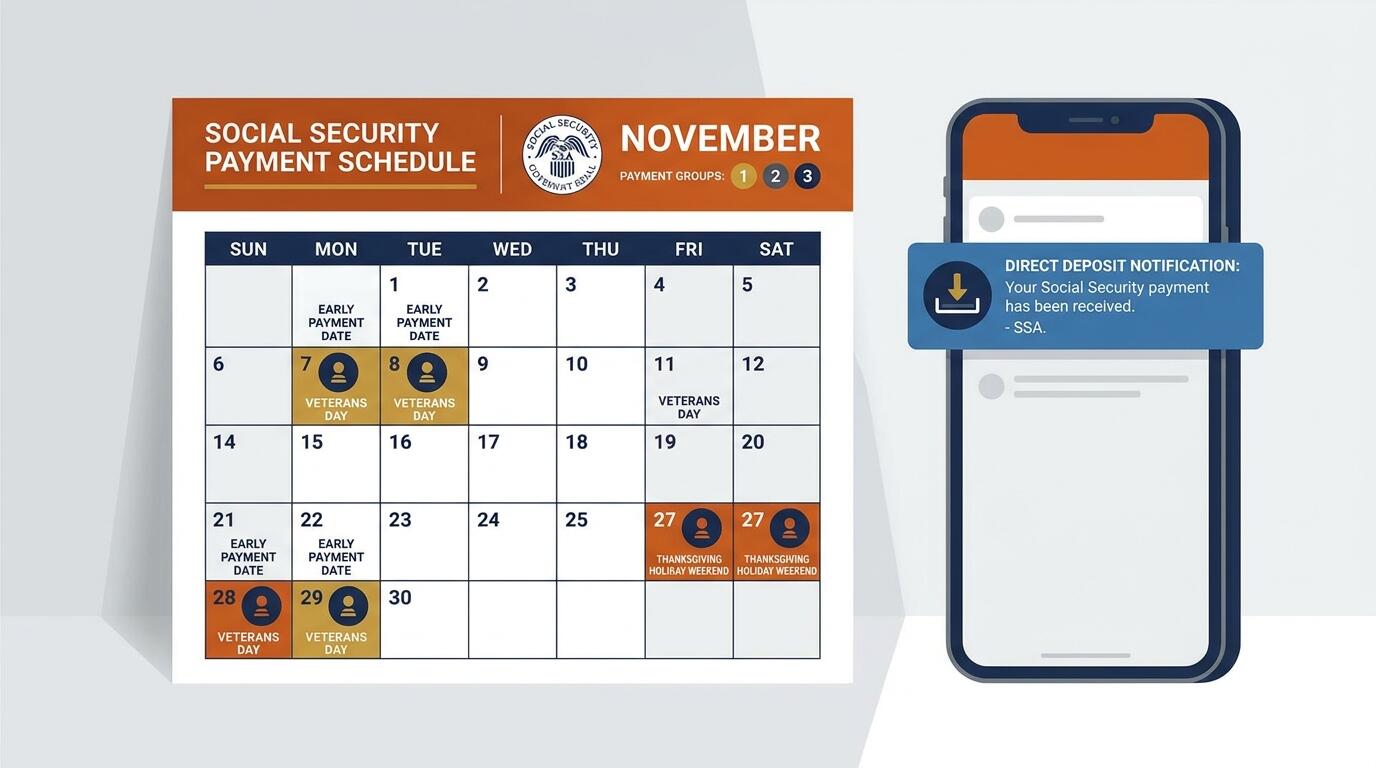
ALT: Social Security payment schedule showing early November checks arriving before the holiday weekend
What's Behind the Early Social Security Payments This November?
If you rely on Social Security benefits, you may have noticed that some payments hit bank accounts earlier than usual this November — or perhaps someone you know mentioned receiving what looked like an extra deposit. This isn't a mistake or a one-time bonus. It follows a predictable, rule-based system that the Social Security Administration applies whenever a regularly scheduled payment date falls on a weekend or federal holiday. Understanding exactly how that works can save beneficiaries real anxiety and help them budget more accurately.
The Social Security payment calendar is not as random as it can sometimes feel, but it does shift in ways that catch people off guard — especially around holiday-heavy months like November. This article breaks down why certain recipients get paid ahead of schedule in November, who is affected, how the underlying schedule is structured, and what it means for your month-to-month financial planning.
The State of Social Security Payments Today: How the Schedule Actually Works
The Social Security Administration, commonly referred to as the SSA, is the federal agency responsible for administering retirement, disability, and survivor benefit payments to tens of millions of Americans. The SSA follows a structured payment calendar that distributes funds on specific dates each month, and that calendar is tied to two key variables: when a recipient first became entitled to benefits and their date of birth.
Here is the baseline structure the SSA uses each month:
Beneficiaries who began receiving Social Security before May 1997 — or who receive both Social Security and Supplemental Security Income (SSI) — are paid on the third of each month.
Beneficiaries born on the 1st through the 10th of the month receive their payment on the second Wednesday of the month.
Beneficiaries born on the 11th through the 20th receive payment on the third Wednesday.
Beneficiaries born on the 21st through the 31st receive payment on the fourth Wednesday.
SSI payments, which go to lower-income individuals who are aged, blind, or disabled, follow a slightly different rule: they are paid on the first of each month. When the first falls on a weekend or holiday, SSI is paid on the preceding business day.
This structure is consistent throughout the year — but November creates a scheduling collision that results in at least some payments landing earlier than recipients might expect.
Why November Specifically Triggers Early Payments: The Holiday Overlap Mechanism
November contains Veterans Day on the 11th and Thanksgiving on the fourth Thursday of the month — and those federal holidays directly interact with the SSA's payment calendar in ways that cause dates to shift. When a scheduled payment date lands on a federal holiday or weekend, the SSA moves that payment to the preceding business day.
How Veterans Day Affects the Second Wednesday Payment
Veterans Day is a federal holiday observed on November 11th each year. In years when November 11th falls on a Wednesday, the second Wednesday payment group — beneficiaries born on the 1st through the 10th — would ordinarily receive their payment on that day. Because federal holidays suspend direct-deposit processing through the banking system, the SSA advances those payments to the prior business day, typically Tuesday the 10th or whatever the last working day before the holiday is. The result: those recipients see money arrive a day earlier than they might anticipate.
How Thanksgiving Reshapes the Late-November Cycle
Thanksgiving lands on the fourth Thursday of November, which means it falls on dates ranging from the 22nd to the 28th. The fourth Wednesday — the regular payment date for beneficiaries born between the 21st and 31st — sits immediately before or adjacent to that holiday window. In years when this scheduling creates a conflict, the SSA again advances payment to the preceding business day. In some November cycles, this means beneficiaries in the fourth-Wednesday group see funds arrive days earlier than the equivalent date in other months.
The "Double-Check" Effect for SSI Recipients
Supplemental Security Income recipients face a unique dynamic in November. Because SSI is paid on the first of each month, and December 1st sometimes falls on a weekend or holiday, the SSA will advance December's SSI payment into late November — often the last business day of the month, such as November 28th or 29th. This is not a bonus or error. It is December's SSI payment arriving early. When this happens, SSI recipients who are also budgeting for December need to recognize that the deposit they see at the end of November is intended to cover the following month.
According to CBS News reporting on SSA payment schedules, some Social Security recipients do in fact receive what looks like an additional check in November specifically because of this SSI advance — a nuance that can confuse recipients who aren't tracking the calendar closely.
Why the Banking System Is the Real Gatekeeper
A subtler driver of early payments is the role of the Automated Clearing House network — the ACH system that processes direct deposits across U.S. financial institutions. The ACH network does not process transactions on federal holidays, which means the SSA cannot wait until the holiday to initiate transfers. Financial institutions themselves also sometimes have cutoff times that mean initiating a transfer a day early is necessary to guarantee funds are credited by the intended date. The practical result is that recipients may see funds land in their accounts even before the SSA's adjusted date, depending on their bank's processing times.
Evidence, Real-World Context, and How Different Groups Experience This
The experience of early payments differs meaningfully across the various groups of Social Security recipients — and understanding those differences helps clarify why some people see the shift and others don't notice it at all.
Recipient Group — Standard Payment Date — November Adjustment Trigger — Likely Outcome
Legacy recipients (pre-May 1997) — 3rd of the month — 3rd falls on weekend or holiday — Payment moved to prior business day
Born 1st–10th — 2nd Wednesday — Veterans Day (Nov. 11) falls on Wednesday — Payment may arrive Tuesday or Monday
Born 11th–20th — 3rd Wednesday — Holiday proximity varies by year — Minimal shift in most years
Born 21st–31st — 4th Wednesday — Thanksgiving week collision — Payment may arrive days early
SSI recipients — 1st of each month — Dec. 1 falls on weekend or holiday — Nov. 28–29 deposit (Dec.'s payment)
This table captures the structural logic, but in practice the exact shift depends on the specific calendar of any given year. In some Novembers, multiple groups experience early payments simultaneously — which is why November tends to generate more questions from beneficiaries than almost any other month.
What Recipients and Advocates Consistently Report
In the work of tracking how people engage with financial news around benefits timing, a pattern consistently emerges: recipients are most confused not when payments are late (they know to call their bank or the SSA), but when payments arrive unexpectedly early. A deposit showing up a day or several days before expected can trigger concerns about fraud, database errors, or miscalculations — particularly for older recipients who rely heavily on paper statements or monthly routines built around specific dates.
Advocates for seniors and disability-benefit recipients frequently note that this confusion is preventable with better calendar literacy. The SSA publishes an annual payment schedule, and news outlets including Yahoo Finance have covered the November 2025 schedule specifically, helping recipients know what to expect in advance. For those curious about broader changes to Social Security — including adjustments to benefit amounts — the annual cost-of-living adjustment (COLA) is a related topic worth understanding, and Social Security's COLA framework and what it means for retirees provides useful context on how benefit levels shift from year to year.
Competing Interpretations: Confusion vs. Opportunity
Some financial advisors frame early November payments as a minor planning opportunity — when funds arrive ahead of Thanksgiving, recipients have slightly more flexibility in managing holiday-related expenses. Others caution against treating an early payment as extra money, precisely because of the SSI scenario: the late-November deposit that represents December's payment can leave a recipient short in December if they spend it as though it belongs to November.
Perspective / Approach — Strengths — Trade-offs — Best Fit
Treat early payment as extra funds — Creates short-term spending flexibility — Risks underfunding the following month (especially for SSI) — Beneficiaries with supplemental income streams
Treat early payment as next month's funds — Protects against cash shortfall in December — May feel overly conservative for most recipients — SSI-only recipients and tight budgets
Track the SSA calendar proactively — Eliminates confusion, supports planning — Requires annual calendar check — All recipients who want reliable budgeting
What This Means Going Forward: Outlook and Practical Implications
Social Security payment scheduling is not changing in any fundamental way — the SSA's rules around holiday and weekend adjustments have been consistent for years. What does change is the specific calendar configuration each November, which means the exact pattern of early payments shifts from one year to the next. In some years, Veterans Day's placement creates the biggest disruption; in others, Thanksgiving timing is the dominant factor.
For beneficiaries, the most actionable implication is straightforward: check the SSA's official published payment schedule at the start of each year, and flag November in particular for potential date shifts. The SSA publishes this schedule on its official website, ssa.gov, and major financial news outlets typically recap it as November approaches.
Several broader dynamics are worth keeping in mind for anyone who depends on Social Security income:
Banking delays cut both ways. While the ACH system can deliver funds a day early when the SSA initiates transfers ahead of a holiday, it can also introduce processing lags depending on your financial institution. Credit unions and smaller banks sometimes take an extra business day to post deposits.
Direct deposit is more reliable than paper checks. Beneficiaries who still receive paper checks face a longer and less predictable delivery window around holidays. The SSA has long encouraged direct deposit enrollment for this reason.
The SSI advance isn't a windfall. When December's SSI payment arrives in late November, it is easy to misread the bank balance. Recipients who budget month-to-month should label that deposit mentally as December income.
Economic policy shifts can affect benefit amounts, not just timing. For anyone tracking Social Security more broadly, policy changes at the federal level — including discussions around retirement age, COLA calculations, and program funding — represent a separate but important layer of financial planning that goes well beyond scheduling adjustments.
For younger readers who are just beginning to think about Social Security — whether for their own future planning or to help an older family member navigate the system — it's worth understanding that Social Security doesn't exist in isolation. It connects to broader economic forces, including how the Federal Reserve's interest rate decisions shape the overall financial environment that retirees live in. How the Federal Reserve's current rate decisions affect your mortgage and savings offers one lens into that wider economic picture.
ALT: Calendar showing Social Security November payment dates shifted earlier due to Veterans Day and Thanksgiving federal holidays
Q1: How do I know if my Social Security payment will arrive early in November?
Your payment date depends on your birth date and the type of benefit you receive. If you receive SSI, check whether December 1st falls on a weekend or holiday — if it does, your November-end deposit is actually December's advance payment. For regular Social Security, look up the official SSA payment calendar on ssa.gov and note whether your scheduled Wednesday falls near Veterans Day (November 11th) or Thanksgiving week. The SSA announces adjusted dates in advance, and major financial news sources recap them seasonally.
Q2: Is an early Social Security payment a sign of a policy change or new benefit?
No — an early payment is not a new benefit, a raise, or a policy change. The Social Security Administration advances payments by one or more business days whenever a scheduled date lands on a federal holiday or weekend. This is a long-standing administrative rule, not an expansion of benefits. The dollar amount of your payment does not change; only the timing shifts. If you believe your payment amount has changed unexpectedly, contact the SSA directly rather than assuming the schedule change is the cause.
Q3: When does the early November Social Security payment situation typically occur, and does it happen every year?
The timing shifts in November are not identical every year — they depend on how Veterans Day (November 11th) and Thanksgiving (fourth Thursday of November) align with the SSA's Wednesday-based payment schedule in any given year. In most Novembers, at least one beneficiary group experiences an earlier-than-usual payment, and SSI recipients frequently see a December advance deposited in late November. Checking the SSA's published annual payment calendar each January gives you the most accurate picture of how that specific year's schedule plays out.
Summary
November's early Social Security payments are the result of a predictable, rules-based scheduling system — not errors, bonuses, or policy changes. Here are the core takeaways from this analysis:
The SSA moves payments earlier whenever a scheduled date lands on a federal holiday or weekend. Veterans Day and Thanksgiving are November's two primary triggers, and they affect different groups of beneficiaries depending on the year's specific calendar.
SSI recipients face the most distinctive scenario. When December 1st falls on a weekend or holiday, December's SSI payment is advanced to late November — meaning a November deposit is actually next month's income.
Your payment group is determined by your birth date and when you first received benefits. Beneficiaries born on the 1st–10th, 11th–20th, and 21st–31st each have different standard payment Wednesdays and therefore experience November shifts differently.
Early payments are not extra money. Treating an advanced payment as a windfall — especially in the SSI advance scenario — can leave recipients short in December.
Proactive calendar-checking is the simplest solution. The SSA publishes its full payment schedule annually, and major outlets cover November dates specifically as the month approaches.
The best next step is to look up the official SSA payment schedule for the current year and note any adjusted November dates that apply to your benefit type and birth date. Knowing what to expect removes the anxiety of unexpected deposits and helps you plan around the holiday season with confidence.
Want to make sense of the latest financial headlines without the jargon? Vega Brief breaks down complex economic, market, and personal finance news into clear, plain-English explainers — strictly educational and always source-linked. Visit Vega Brief to stay informed and build your financial literacy, one story at a time.
Sources
Social Security Administration. "Social Security Payment Schedule".
https://www.ssa.gov
Yahoo Finance. "Social Security November 2025: When Your Checks Will Arrive".
https://finance.yahoo.com/news/social-security-november-2025-checks-110022511.html
CBS News. "Some Social Security Recipients Will Get an Extra Check in November".
https://www.cbsnews.com/news/social-security-administration-payments-november-29-extra-check-schedule/
YouTube / Social Security News Coverage. "Social Security Checks: November 2025 Payment Schedule".
https://www.youtube.com/watch?v=v5xxj0hE5KI
U.S. Department of the Treasury. "Federal Benefits Payment Schedule and Direct Deposit".
https://www.treasury.gov
Note: Payment schedules are subject to annual updates; please check the latest official SSA calendar or consult a qualified benefits advisor for guidance specific to your situation.
For educational purposes only. Not investment advice. We do not recommend any stock, fund, broker or trading platform. Headlines are sourced from Google News · Business; every story links to the original publishers.