Understanding High-Yield Savings Accounts in a Changing Rate Environment
ALT: High-yield savings accounts explained in a changing interest rate environment for everyday savers
For educational purposes only. Not investment advice.
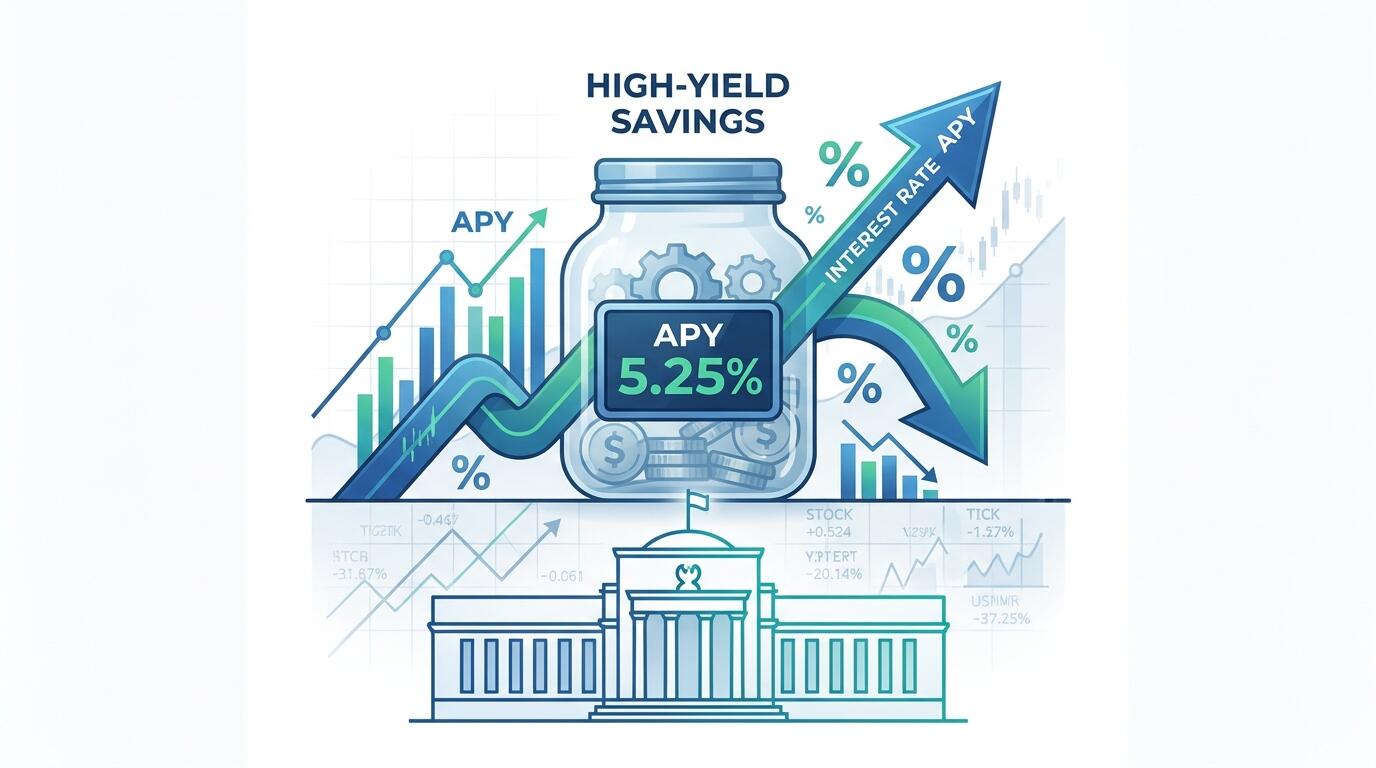
ALT: High-yield savings accounts explained in a changing interest rate environment for everyday savers
Why High-Yield Savings Accounts Are Worth Understanding Right Now
High-yield savings accounts are deposit accounts, typically offered by online banks and financial institutions, that pay significantly more interest than a standard savings account — often by a meaningful multiple — making them one of the most accessible tools for growing idle cash. In a period when central banks have been actively adjusting interest rates in response to inflation, economic growth concerns, and shifting monetary policy signals, understanding how these accounts work and how their returns respond to the broader rate environment is no longer just a niche financial literacy topic. It is genuinely practical knowledge for anyone holding cash in a bank account.
The reason this topic deserves careful attention now is that the rate environment itself is in transition. After years of historically low rates, followed by an aggressive rate-hiking cycle, many central banks — including the U.S. Federal Reserve — have entered a more uncertain phase of policy, weighing whether to hold rates steady, cut further, or respond to new economic pressures. That pivot directly affects what high-yield savings accounts pay. Savers who do not understand the relationship between policy rates and deposit yields risk misreading their options, missing opportunities, or being caught off guard when their account's annual percentage yield quietly drifts downward.
The State of High-Yield Savings: How We Got Here and Where Things Stand
High-yield savings accounts are not a new concept, but they became dramatically more relevant during the rate-hiking cycle that followed the post-pandemic inflation surge. For years prior, near-zero interest rate policy meant that even "high-yield" accounts paid almost negligible returns, and most consumers had little reason to compare banks. The sharp rise in the federal funds rate changed that calculus almost overnight, pushing yields on the best high-yield savings accounts to levels many savers had never seen in their lifetimes.
That period rewarded savers who paid attention. Online banks, credit unions, and some fintech-adjacent platforms competed aggressively for deposits, passing along much of the rate increase to account holders in the form of higher annual percentage yields. A high-yield savings account is broadly defined as an FDIC-insured (in the United States) or similarly government-backed deposit account that offers a yield materially above the national average for savings accounts, which is published regularly by the Federal Deposit Insurance Corporation (FDIC) and the Federal Reserve.
Understanding the present landscape requires appreciating two dynamics simultaneously. First, the elevated rate environment made high-yield savings accounts genuinely competitive with short-term Treasury bills and certificates of deposit for the first time in years. Second, rates on these accounts are variable — they are not locked in. As central banks signal rate cuts or actually reduce the benchmark rate, banks lower their deposit yields, often faster than many savers expect. A pattern that consistently surfaces in financial news coverage is the gap between when savers open an account expecting a given yield and when they eventually notice that yield has been quietly reduced.
Today, the environment is characterized by uncertainty rather than a clear directional trend. The Federal Reserve's approach to rate decisions — including the factors that drive them — is something Vega Brief has explained in detail, covering how those decisions ripple into both mortgage rates and savings yields. For savers, the key takeaway from the current landscape is this: the advantageous yields of recent years are not permanent fixtures, and treating them as such is a common and costly mistake.
How High-Yield Savings Accounts Actually Work: The Mechanics Behind the Yield
High-yield savings accounts pay higher interest than traditional accounts because of the underlying business model of the institutions that offer them, the competitive dynamics of deposit gathering, and the direct link between benchmark policy rates and what banks can profitably pay depositors.
The Federal Funds Rate Connection
The federal funds rate is the interest rate at which banks lend reserve balances to each other overnight, set by the Federal Open Market Committee (FOMC) of the U.S. Federal Reserve. When the FOMC raises this rate, borrowing becomes more expensive throughout the economy — but it also means banks can earn more by holding reserves. This creates room for banks to offer higher deposit yields without losing money. The reverse is equally true: when the FOMC cuts rates, that margin compresses, and banks lower their savings account yields — often within weeks of a rate decision.
This connection explains why high-yield savings account rates moved so dramatically in recent years and why they are now under downward pressure in many institutions. Savers should understand that the yield advertised on a high-yield savings account is an annual percentage yield (APY), which reflects compound interest over a year and is not fixed. Banks can — and routinely do — adjust it at any time, usually with minimal notice, and the fine print of most account agreements explicitly allows this.
Why Online Banks Tend to Pay More
Online banks and digital-first financial institutions typically offer higher yields on savings accounts than traditional brick-and-mortar banks. The reason is structural: online banks have lower overhead costs — no physical branch network, fewer staff per customer — and can pass some of those savings to depositors in the form of higher interest. They also use high APYs as a primary customer acquisition tool, since they cannot compete on physical convenience. This is not a guarantee that online bank yields will always be superior, but it is a consistent pattern that shapes how the high-yield savings market is structured.
The Role of FDIC Insurance and Safety
One of the most important features of a high-yield savings account — and one that distinguishes it from other higher-yield options like money market funds or Treasury securities — is deposit insurance. In the United States, the FDIC insures deposits at member banks up to a defined limit per depositor, per institution, per ownership category. This means that within those limits, the account holder's principal is protected even if the bank fails. The Federal Deposit Insurance Corporation sets and enforces these limits, making FDIC-insured high-yield savings accounts one of the lowest-risk savings vehicles available.
Understanding the insurance limit is not a minor detail. A pattern we consistently see in financial news coverage involves savers who hold amounts exceeding the insured threshold at a single institution without realizing part of their balance is unprotected. Checking coverage through the FDIC's official resources before depositing large sums is a straightforward precaution.
How Compounding Frequency Affects Your Return
Compounding refers to the process by which earned interest is added to the principal, and that combined balance then earns interest in the next period. High-yield savings accounts typically compound daily or monthly. While the difference between daily and monthly compounding at similar APY levels is modest, it is real — and the APY figure accounts for this by standardizing returns to an annual basis. When comparing accounts, always compare APYs rather than nominal interest rates to make an apples-to-apples comparison.
Evidence and Competing Approaches: How High-Yield Savings Stack Up Against Alternatives
High-yield savings accounts are not the only option for savers seeking to maximize returns on cash held outside of investment markets. The table below offers an honest comparison of several common approaches, capturing their trade-offs without advocating for any particular product.
Perspective / Approach — Strengths — Trade-offs — Best Fit
High-Yield Savings Account — FDIC-insured, liquid, easy access, variable yield tracks rate environment — Yield falls when rates fall; not locked in — Emergency fund, short-term savings goals
Certificate of Deposit (CD) — Fixed rate for a set term; protects yield if rates drop — Early withdrawal penalties; illiquid during term — Savers confident they won't need funds before maturity
Treasury Bills / I-Bonds — Backed by U.S. government; competitive yields; certain tax advantages — Less liquid; purchase limits apply to I-Bonds; requires separate account setup — Savers comfortable with slightly more complexity
Money Market Mutual Fund — Typically higher yields than traditional savings; very liquid — Not FDIC-insured; principal technically at risk (though rare); yield varies — Savers with brokerage accounts seeking cash-equivalent yield
Traditional Bank Savings Account — Maximum convenience; often linked to checking — Yields significantly lower than alternatives; rarely competitive — Operational cash only, not savings optimization
The comparison reveals a fundamental tension: liquidity versus yield stability. High-yield savings accounts offer daily liquidity — you can withdraw your money at any time without penalty — but at the cost of a variable rate. Certificates of deposit lock in a rate but penalize early exit. This trade-off becomes especially important in a rate-cutting environment, where savers who anticipated the direction of monetary policy and locked in a CD rate before cuts may be better positioned than those who remained in variable-rate savings accounts.
A nuance that often goes underappreciated is the tax treatment of interest earned in high-yield savings accounts. Interest income from these accounts is taxed as ordinary income in the United States, at the account holder's marginal rate. This contrasts with certain Treasury securities, where interest is exempt from state and local income taxes — a meaningful difference for savers in high-tax states. The Internal Revenue Service (IRS) provides guidance on the taxability of interest income, and this distinction is worth factoring into any honest comparison of after-tax yields.
Outlook and What It Means for Your Savings Strategy
The trajectory of high-yield savings account yields is directly tied to the path of central bank policy, which remains genuinely uncertain. Qualitatively, the Federal Reserve has signaled a cautious approach to rate adjustments, balancing the goal of bringing inflation sustainably to its target with the risk of cooling economic activity too sharply. This means savers should not expect yields to return to the peaks seen during the most aggressive phase of rate hikes, nor should they assume yields will collapse to near-zero overnight. The honest answer is that the path is uncertain, and planning for that uncertainty is more useful than predicting a specific outcome.
For readers who want to situate this savings question within the broader economic picture — including how large-scale investment trends are reshaping growth expectations — understanding the macroeconomic backdrop matters. Factors like AI-driven investment flows and their effect on global growth are shaping the environment in which the Federal Reserve makes its rate decisions, which in turn flows directly into the yields savers see on their accounts.
Several practical principles follow from this analysis:
Treat the current yield on a high-yield savings account as temporary and subject to change — build your financial plan around realistic scenarios, not the best-case rate.
If you have cash you are confident you will not need for six to eighteen months, comparing current CD rates against high-yield savings yields is a worthwhile exercise, especially if rates appear likely to fall further.
Keep emergency fund savings in an account where liquidity is guaranteed — high-yield savings accounts serve this purpose well, even if their yield compresses over time.
Check your account's current APY periodically rather than assuming it matches what was advertised when you opened it. Banks lower rates quietly, and the only way to catch this is to look.
Confirm that your total deposits at any single FDIC-member institution stay within insured limits, and investigate multi-bank strategies or account structures if your balances exceed those thresholds.
The broader lesson is that high-yield savings accounts are a useful tool within a well-considered savings strategy, not a passive set-and-forget solution. The rate environment will continue to evolve, and staying informed is the most reliable way to avoid being caught on the wrong side of a rate change.
ALT: Comparison of high-yield savings account yields versus other savings vehicles in a changing interest rate environment
Q1: How does the Federal Reserve's rate policy affect the APY on my high-yield savings account?
When the Federal Reserve raises the federal funds rate, banks can earn more on their own reserves, which creates room for them to offer higher yields on deposits like high-yield savings accounts. When the Fed cuts rates, that margin shrinks, and banks typically lower their deposit yields — often within weeks. The Federal Reserve publishes detailed information about its rate-setting process, and because high-yield savings accounts carry variable rates, their yields move with the policy rate rather than being locked in at any level.
Q2: Are high-yield savings accounts safe, and how does FDIC insurance actually protect me?
High-yield savings accounts at FDIC-member banks are among the safest savings vehicles available for amounts within the insured limits. The FDIC insures deposits up to a defined threshold per depositor, per institution, per ownership category — meaning your principal is protected even if the bank fails, up to that limit. Amounts above the threshold at a single institution are not insured, which is why savers with larger balances should verify their coverage carefully using the FDIC's official tools. Safety within the insured limit is essentially equivalent to a traditional savings account.
Q3: How long does it typically take for a high-yield savings account rate to drop after a Fed rate cut?
There is no fixed timeline, but in practice banks tend to lower their advertised APYs within a few weeks of a Federal Reserve rate cut, and sometimes even in anticipation of one. Some institutions move more quickly than others, and competitive pressure can slow the decline if banks are actively competing for deposits. The key risk for savers is assuming rates are stable when they are not — checking your account's current APY regularly, rather than relying on what was advertised at opening, is the most practical way to stay current. The Federal Reserve's rate decisions are publicly announced after each FOMC meeting.
Summary
High-yield savings accounts are variable-rate, FDIC-insured deposit accounts that offer meaningfully higher interest than traditional savings accounts — but their yields rise and fall with the Federal Reserve's benchmark rate, making them dynamic tools rather than fixed-return products.
Key Takeaways:
High-yield savings account APYs are variable and directly linked to the federal funds rate; they will decline when the Federal Reserve cuts rates, often within weeks of a policy decision.
FDIC insurance protects deposits at member banks up to established limits per depositor, per institution — amounts above that threshold are not insured and require careful planning.
Online banks tend to offer higher yields than traditional banks due to lower overhead costs, but this advantage narrows when competitive pressure for deposits eases.
Comparing after-tax yields across savings vehicles — including CDs, Treasury bills, and money market funds — gives a more complete picture than looking at APY alone.
Regularly checking your account's current APY is the single most important habit for savers in a changing rate environment, since banks adjust rates quietly and without fanfare.
The next practical step is to review your current savings account's APY today, compare it against alternatives that suit your liquidity needs, and make sure your balances fall within FDIC coverage limits. Staying informed about monetary policy developments — without having to parse dense central bank statements yourself — is what turns knowledge into action.
Want to make sense of today's financial headlines without the jargon? Visit Vega Brief for plain-English explainers on the economic stories that matter most — from Federal Reserve rate decisions to personal finance news, all backed by cited sources and written strictly for your education. Bookmark Vega Brief and turn financial confusion into confident understanding, one story at a time.
Sources & Citations
Federal Deposit Insurance Corporation (FDIC). "Deposit Insurance FAQs and Coverage Information".
https://www.fdic.gov
Board of Governors of the Federal Reserve System. "Federal Open Market Committee: Rate Decisions and Monetary Policy Explanations".
https://www.federalreserve.gov
Internal Revenue Service (IRS). "Taxability of Interest Income and Reporting Requirements".
https://www.irs.gov
Consumer Financial Protection Bureau (CFPB). "Understanding Savings Accounts, Annual Percentage Yield, and Deposit Products".
https://www.consumerfinance.gov
U.S. Department of the Treasury. "Treasury Securities, I-Bonds, and Savings Instruments Overview".
https://www.treasury.gov
Note: Financial regulations, deposit insurance limits, and interest rate benchmarks are subject to change. Always check the latest official guidance from relevant government agencies or consult a qualified financial professional before making savings decisions.
For educational purposes only. Not investment advice. We do not recommend any stock, fund, broker or trading platform. Headlines are sourced from Google News · Business; every story links to the original publishers.