How Rising Medicare Premiums Could Offset Your Next Social Security Raise
ALT: Rising Medicare premiums offsetting Social Security COLA raise for retirees and older Americans
For educational purposes only. Not investment advice.
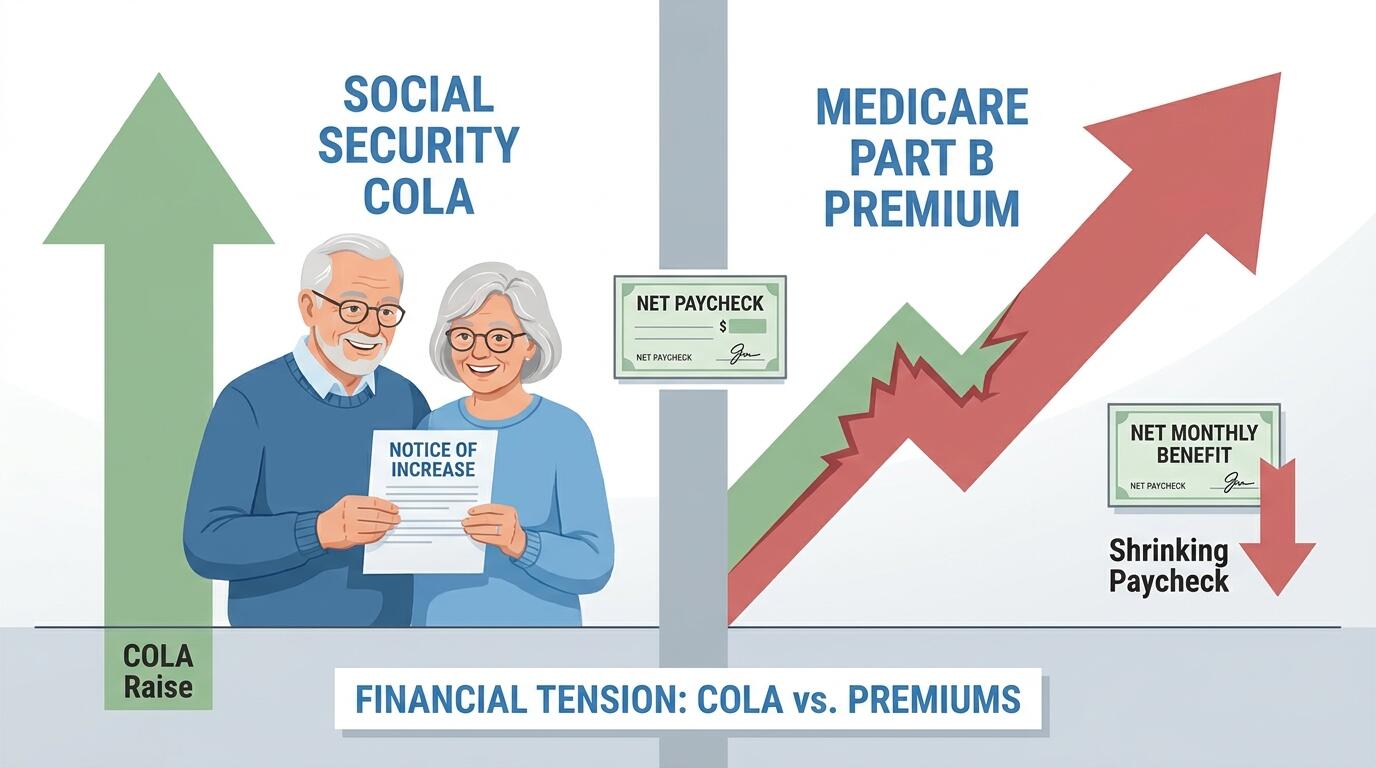
ALT: Rising Medicare premiums offsetting Social Security COLA raise for retirees and older Americans
Why Your Social Security Raise Might Not Feel Like a Raise at All
The single most common question we hear from readers in the lead-up to any new year is simple: "I heard my Social Security payment is going up — so why does my bank account look exactly the same?" The short answer is that Medicare Part B premiums are deducted directly from most Social Security checks, and when those premiums rise faster than the cost-of-living adjustment (COLA) applied to benefits, retirees can end up with less actual spending money than before — even after a nominal raise.
This is not a niche concern. It is a structural feature of how the two programs interact, and it affects tens of millions of Americans every year. The following list breaks down the key mechanisms at work — from how COLA is calculated, to how the "hold harmless" rule functions, to what beneficiaries in different situations actually experience. Each item is drawn from publicly documented program rules maintained by the Social Security Administration (SSA) and the Centers for Medicare and Medicaid Services (CMS). Use this list to understand the landscape, identify where you or someone you know might fall, and ask sharper questions of any advisor or benefits counselor you consult.
What the Social Security COLA Actually Is — and How It Is Calculated
The Social Security cost-of-living adjustment (COLA) is an annual percentage increase applied to Social Security retirement, disability, and survivor benefits. The COLA is tied directly to the Consumer Price Index for Urban Wage Earners and Clerical Workers (CPI-W), a measure published by the U.S. Bureau of Labor Statistics. Specifically, the SSA compares the average CPI-W reading from the third quarter of the current year to the same period from the prior year, and the resulting percentage change becomes the following year's COLA.
The intent behind COLA is straightforward: protect beneficiaries from inflation eroding the purchasing power of fixed payments. In years when inflation is high, COLA can be substantial. In years when inflation cools, COLA shrinks or, in some historical cases, reaches zero. The critical point is that COLA is calculated using a broad measure of inflation that covers working-age urban consumers — not a measure specifically weighted toward the spending patterns of older adults, who tend to spend more on housing and healthcare.
Best for: Understanding the baseline — everyone receiving Social Security benefits needs to know this number before evaluating any other change.
Watch out: CPI-W does not heavily weight medical costs the way retirees actually experience them, meaning COLA can understate the true inflation felt by older households in high-healthcare-spending years.
How Medicare Part B Premiums Are Deducted — and Why Timing Matters
Medicare Part B is the component of Medicare that covers outpatient services, doctor visits, and certain preventive care. The standard monthly Part B premium is set annually by the Department of Health and Human Services, and for the vast majority of Medicare beneficiaries who also collect Social Security, that premium is automatically deducted from the monthly Social Security payment before it reaches the beneficiary's account.
This deduction mechanism is what creates the mathematical tension at the heart of this issue. When the Medicare Part B premium increases from one year to the next, that increase directly reduces the net amount a beneficiary receives. If the COLA percentage applied to a person's gross benefit is smaller in dollar terms than the dollar increase in the Part B premium, the net check shrinks. The gross benefit technically went up; the take-home amount went down.
Best for: Anyone who receives both Social Security and Medicare — which describes the large majority of Americans aged 65 and over.
Watch out: Part B premiums are announced separately from COLA, often at a different point in the year, making it easy to hear the COLA announcement and assume a straightforward raise without yet knowing the premium offset.
The "Hold Harmless" Rule — Protection With Real Limits
The "hold harmless" provision is a federal rule that prevents most Social Security beneficiaries from seeing their net monthly payment fall below the prior year's amount as a direct result of a Medicare Part B premium increase. In practical terms, if a beneficiary's COLA dollar increase is smaller than the planned Part B premium hike, their individual premium is capped at whatever dollar amount leaves their net check unchanged — effectively passing the excess cost on to other beneficiaries or to general Medicare funding.
This sounds like complete protection, but the hold harmless rule has significant limitations. It applies only to the net check amount — it does not guarantee that your purchasing power remains the same, only that your payment does not fall in nominal dollar terms. Additionally, roughly one in four Medicare beneficiaries is not covered by hold harmless at all: this group includes new Medicare enrollees, people who pay Part B premiums directly (because they are not yet collecting Social Security), those subject to income-related premium surcharges (called IRMAA), and people whose Social Security benefits are paid by a government pension offset.
Best for: Existing Social Security beneficiaries in lower-to-middle income brackets who are already enrolled in both programs — this is the group the rule is designed to protect.
Watch out: Hold harmless creates a kind of premium inequality in years of large Part B increases: those not covered pay the full standard premium increase, while those covered pay less — a gap that future premium-setting must account for.
Income-Related Medicare Adjustment Amounts (IRMAA) — When Higher Earners Face a Steeper Climb
IRMAA is a surcharge added on top of the standard Medicare Part B (and Part D) premium for beneficiaries whose income exceeds certain thresholds. The Social Security Administration determines IRMAA eligibility using income reported on federal tax returns from two years prior — so a beneficiary's 2024 IRMAA determination is based on 2022 tax data. The surcharge is structured in tiers, with higher income brackets paying progressively larger amounts above the standard premium.
For beneficiaries subject to IRMAA, the offset against COLA can be considerably larger than what a standard-premium enrollee experiences. A retiree in an upper IRMAA tier might be paying monthly Part B costs that are multiple times the standard premium, meaning even a reasonably generous COLA percentage — expressed in dollars against a typical benefit amount — can be fully absorbed and then some. IRMAA is also not covered by hold harmless, which compounds the exposure. Beneficiaries who experience a one-time income spike — from a Roth conversion, a property sale, or a required minimum distribution (RMD) — sometimes find themselves in a higher IRMAA bracket in a year they did not expect.
Best for: Retirees and near-retirees with higher income, those managing large asset portfolios, or anyone who recently had an unusually high-income year.
Watch out: IRMAA decisions can be appealed using a "life-changing event" form (SSA Form SSA-44) if income has since dropped, but the appeal process takes time and documentation.
The Compounding Effect — Small Percentage Changes, Large Dollar Consequences
The relationship between COLA and premium changes is not just about the current year in isolation. It compounds over time. A retiree whose net benefit is incrementally held flat or grows only slightly in nominal terms, while actual healthcare inflation and general cost-of-living pressures continue, faces a gradual erosion of real purchasing power that may not be visible in any single year's announcement.
Consider the structural math: a COLA expressed as a percentage of a benefit amount produces a dollar increase that varies by how large the underlying benefit is. A person receiving a modest monthly benefit sees a smaller COLA dollar gain than someone receiving a higher benefit — even at the identical percentage. Meanwhile, the Part B premium increase is a flat dollar amount applied uniformly regardless of benefit size. This means lower-benefit recipients are structurally more exposed to net-check erosion than higher-benefit recipients at any given COLA percentage.
Best for: Anyone trying to plan long-term retirement budgets — this compounding dynamic is especially relevant for people 10 or more years from retirement who want to model realistic income trajectories.
Watch out: Financial media often reports COLA as a positive headline without contextualizing the Part B premium offset, which can leave readers with an inaccurate picture of what actually hits bank accounts.
Medicare Part D and Supplemental Coverage — The Premiums Beyond Part B
Medicare Part B is the most widely discussed premium because of its automatic deduction from Social Security checks, but it is not the only premium that can offset benefit income. Medicare Part D — prescription drug coverage — also carries its own monthly premium, which varies by plan and is subject to its own IRMAA surcharge for higher-income enrollees. Additionally, many Medicare beneficiaries pay premiums for Medigap (supplemental) policies or Medicare Advantage plans, costs that are paid separately and not subject to hold harmless rules.
When all premium costs are totaled, the full picture of what a Medicare beneficiary spends on coverage can substantially exceed the Part B standard premium alone. In years where COLA is modest, a beneficiary juggling Part B, Part D, and a supplemental policy premium may find that combined premium increases consume the entire nominal benefit increase and more, all without any single line item technically violating the hold harmless rule.
Best for: Beneficiaries enrolled in comprehensive Medicare coverage — particularly those on multiple medications requiring robust Part D plans, or those with Medigap policies.
Watch out: Unlike Part B, Part D and Medigap premiums are not automatically deducted from Social Security for all plan types, which can make the full cost less visible until billing arrives.
What Happens in a Zero-COLA Year or a Very Low-COLA Year
In years when COLA is zero or very small — which has occurred multiple times in Social Security's history when CPI-W readings were flat — the hold harmless rule is triggered for most existing beneficiaries, capping their Part B premium increase to prevent a net-check decline. However, those not covered by hold harmless (new enrollees, IRMAA payers, and others) must absorb the full standard premium increase, and the standard premium in those years can rise steeply because the cost-sharing across beneficiaries shifts.
This dynamic means that a zero-COLA year can actually produce some of the largest Medicare premium jumps for the unprotected minority of enrollees — the opposite of intuition. New retirees who begin claiming Social Security in a low-COLA environment, and who are simultaneously enrolling in Medicare for the first time, can enter the system at a premium level significantly higher than the one long-time beneficiaries are paying, with no hold harmless cushion to ease the entry.
Best for: People approaching Medicare and Social Security enrollment age who want to time or sequence their enrollment decisions strategically.
Watch out: Entering Medicare in a low-COLA year as a new enrollee can result in paying materially higher premiums than older cohorts — a disparity that may persist for years in how different cohorts experience the program's cost structure.
ALT: Chart illustrating how Medicare Part B premium increases can offset Social Security COLA raises for retirees, reducing net monthly income
Quick Comparison at a Glance
Understanding how each of these mechanisms interacts with a retiree's net income requires keeping the distinctions clear. The table below summarizes the key factors.
Mechanism — Best For — Key Strength — Limitation
Social Security COLA — All beneficiaries tracking nominal benefit increases — Inflation-indexed annual adjustment tied to CPI-W — Uses a working-age index that may understate retiree inflation
Part B Premium Deduction — All dual Social Security/Medicare enrollees — Automated and predictable annual adjustment — Can directly offset or exceed COLA dollar gains
Hold Harmless Rule — Existing lower-to-middle income beneficiaries — Prevents net-check decline in nominal terms — Does not cover new enrollees, IRMAA payers, or direct-pay enrollees
IRMAA Surcharges — Higher-income retirees managing larger portfolios — Tiered structure based on actual income — Based on two-year-old tax data; one-time income spikes can trigger it
Compounding Effect — Long-term retirement planners — Reveals true multi-year purchasing power trajectory — Rarely communicated clearly by financial or policy media
Part D and Medigap Costs — Comprehensive coverage enrollees — Covers prescription and supplemental costs beyond Part B — Largely invisible in hold harmless discussions
Zero/Low-COLA Year Dynamics — New Medicare enrollees and those not covered by hold harmless — Highlights enrollment timing risk — New enrollees bear disproportionate premium burden in these years
How to Make Sense of Your Own Situation
The most important first step is knowing which category you fall into, because the experience of a Medicare premium offset varies considerably based on a small number of personal factors.
If you are an existing beneficiary collecting Social Security and enrolled in Medicare, start by looking at your annual COLA notice from the SSA and the accompanying Medicare premium notice. Subtract the new Part B premium from your gross benefit increase expressed in dollars — that arithmetic gives you the actual net change to your monthly check. Many beneficiaries in this group are surprised to find that what was announced as a meaningful percentage raise translates to only a few dollars in additional monthly income, or nothing at all.
If you are approaching Medicare enrollment and have not yet claimed Social Security, you are not currently protected by hold harmless. Your first year of Medicare will reflect the full standard premium — or higher if your income qualifies you for IRMAA. Understanding the income thresholds before you enroll, and reviewing your tax return from two years prior (which is the year CMS will use), can help you anticipate your actual premium level rather than assuming you will pay the standard rate.
A common misconception worth addressing directly: many people assume that a larger COLA percentage automatically means more money in their pocket. This is only true if the dollar gain from COLA exceeds any increase in deducted premiums. The percentage headline is real, but the take-home reality depends on the math at the individual level — and that math is driven by both the absolute size of your benefit and the specific premium tier you occupy.
One practical step that consistently proves useful: request or download a personalized Social Security statement from the SSA's online portal, which shows your current benefit amount and allows you to do the side-by-side dollar arithmetic when each year's announcements are made. For Medicare costs, CMS publishes premium and deductible information annually, and that data combined with your income bracket determines your actual Part B and Part D costs.
Q1: How does the Social Security Administration determine my Medicare Part B premium deduction?
The Social Security Administration deducts the Medicare Part B premium directly from most beneficiaries' monthly payments. The standard premium amount is set annually by the Department of Health and Human Services and applies to most enrollees. Your specific deduction may be higher if your income, based on tax returns from two years prior, places you in an IRMAA surcharge tier. The SSA sends a notice each fall detailing the new premium and adjusted benefit amount before the changes take effect in January.
Q2: Are all Social Security recipients protected from net-benefit reductions caused by Medicare premium increases?
No. The "hold harmless" rule protects most existing beneficiaries who have their Part B premiums deducted from Social Security — specifically, those who are not subject to IRMAA surcharges and who were enrolled before a given year's premium increase. New Medicare enrollees, people not yet receiving Social Security, and those in IRMAA income brackets are not covered and must pay the full standard premium, regardless of how small the COLA is that year.
Q3: When are COLA and Medicare premium changes typically announced each year?
The Social Security COLA is typically announced by the SSA in October, based on third-quarter CPI-W data from the Bureau of Labor Statistics. Medicare Part B premium figures for the following year are generally announced by CMS, also in the fall — often in November. Because the two announcements can be separated by weeks, readers may hear the COLA headline before knowing how much of it will be offset by the premium change, which is why it is important to wait for both figures before drawing conclusions.
The Bottom Line
Three core points capture the essential mechanics of this issue. First, the Social Security COLA is a nominal percentage adjustment tied to inflation — it does not automatically translate to more money in your pocket if Medicare premiums rise by an equivalent or greater dollar amount. Second, the hold harmless rule provides a floor for most existing beneficiaries, preventing their net check from falling, but it does not guarantee real purchasing power gains and excludes a meaningful minority of enrollees. Third, compounding matters: a pattern we consistently see in breaking down this topic is that readers underestimate how small annual net-benefit changes accumulate into significant real-income erosion over a decade or more of retirement.
The actionable steps are uncomplicated. Review both the COLA notice and the Medicare premium notice when they are released each fall — do not rely on the COLA headline alone. Calculate the dollar impact, not just the percentage. If your income was unusually high two years ago due to a one-time event, check whether you qualify to appeal your IRMAA determination using the appropriate SSA process. And if you are approaching Medicare enrollment for the first time, factor your expected premium level into your monthly budget before — not after — choosing your enrollment timing.
Financial headlines about Social Security and Medicare are notoriously easy to misread. The numbers are real; the nuance is what requires attention.
Want to make sense of the latest financial headlines without the jargon? Vega Brief breaks down complex economic, market, and personal finance news into clear, plain-English explainers — strictly educational and always source-linked. Visit to stay informed and build your financial literacy, one story at a time.
Sources & Further Reading
U.S. Social Security Administration. "Cost-of-Living Adjustment (COLA) Information."
https://www.ssa.gov
Centers for Medicare and Medicaid Services (CMS). "Medicare Costs: Premiums, Deductibles, and Coinsurance."
https://www.cms.gov
U.S. Bureau of Labor Statistics. "Consumer Price Index for Urban Wage Earners and Clerical Workers (CPI-W)."
https://www.bls.gov
For educational purposes only. Not investment advice. We do not recommend any stock, fund, broker or trading platform. Headlines are sourced from Google News · Business; every story links to the original publishers.