What a Rising Unemployment Rate Signals About the Economy This Quarter
ALT: Rising unemployment rate graph signaling economic slowdown and recession risk this quarter
For educational purposes only. Not investment advice.
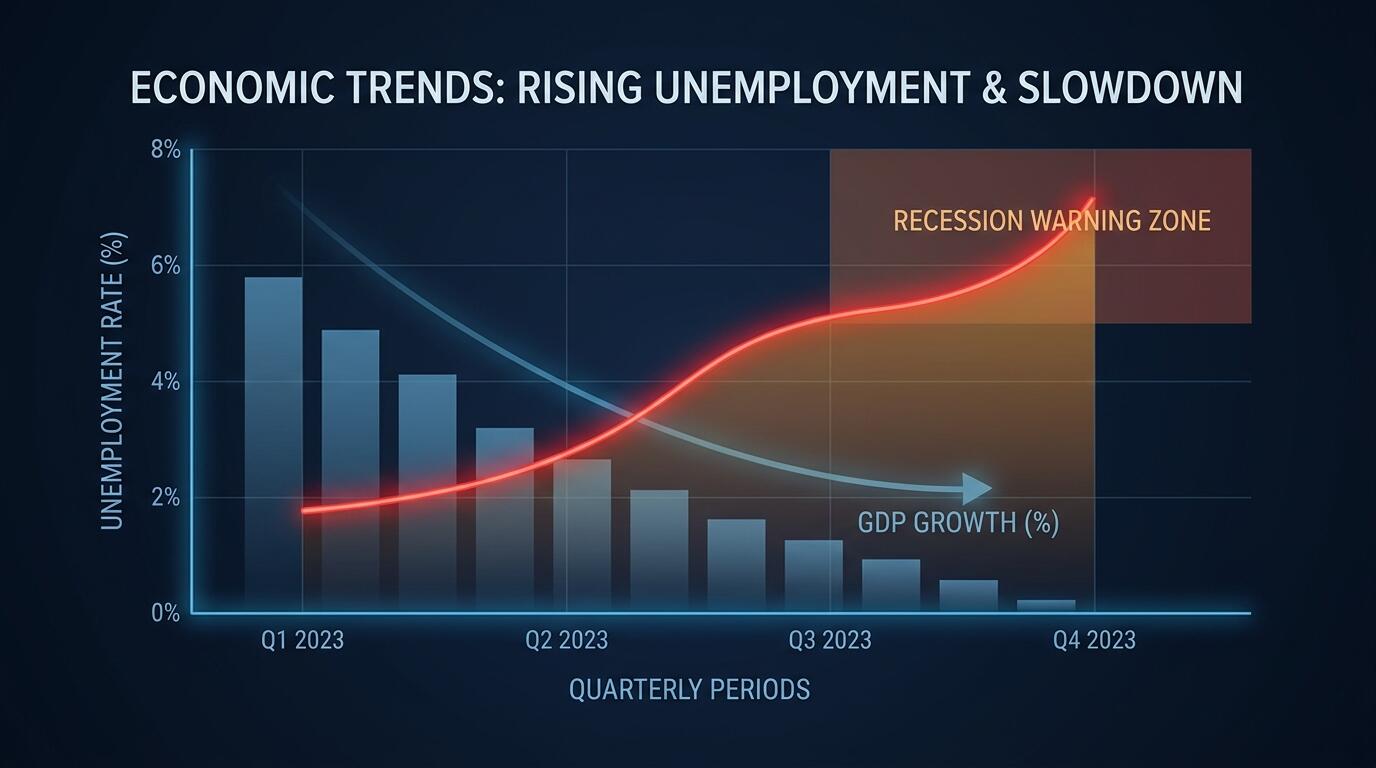
ALT: Rising unemployment rate graph signaling economic slowdown and recession risk this quarter
Why a Rising Unemployment Rate Is One of the Economy's Most Telling Warning Signs
Key Conclusion: A rising unemployment rate signals that the labor market is cooling, businesses are pulling back on hiring or cutting jobs, and economic momentum may be slowing. When joblessness climbs consistently over a quarter, it can foreshadow weakening consumer spending, tighter credit conditions, and in some cases, the early stages of a recession — making it one of the most closely watched indicators in economic analysis.
When unemployment begins to rise, it rarely does so quietly. The shift tends to ripple through economic data within weeks — consumer confidence dips, retail sales slow, and policymakers start recalibrating their playbooks. In our work explaining financial headlines, a pattern we consistently see is that this single metric often triggers a cascade of news stories that can feel overwhelming or contradictory to anyone without an economics background.
This article breaks down what a rising unemployment rate actually signals, why it matters right now, how it relates to other economic indicators, and — critically — what common misreadings of this data can cost you in terms of understanding the bigger picture.
Who Should Pay Attention to Unemployment Data This Quarter
Applicable Scenarios:
You follow financial news and want to understand what rising joblessness actually means for the broader economy
You are a young professional, student, or everyday investor trying to contextualize layoff headlines alongside GDP and inflation reports
You want to understand how labor market data influences central bank decisions, consumer behavior, and market sentiment
Not Applicable/Cautions:
This article is purely educational — it does not constitute investment advice or a recommendation to take any financial action based on economic data
Readers seeking real-time, precise economic forecasting should consult professional economists or licensed financial advisors, as this explainer provides context rather than prediction
The Unemployment Rate Explained: What It Measures and Why It Moves
The unemployment rate is a measure of the share of the labor force that is actively seeking work but currently without a job. It is published monthly by government statistical agencies — in the United States, that is the Bureau of Labor Statistics — and it serves as one of the primary gauges of labor market health.
What makes this metric so important is not just the number itself, but its direction and rate of change. A steady unemployment rate, even if elevated, tells a different story than one that has climbed two or three percentage points within a single quarter. The pace and consistency of the rise matters enormously when economists and policymakers assess whether a slowdown is temporary or structural.
Understanding what drives unemployment higher is equally important. Unemployment generally rises when one or more of the following is happening: businesses are reducing headcount to manage costs, new hiring has slowed because demand for goods and services is weakening, or a sudden shock — such as a financial crisis or global disruption — has forced rapid layoffs. Each cause carries different implications for how long the rise will last and how quickly recovery might follow.
Historically, a sustained increase in joblessness over a full quarter has been a reliable leading indicator that broader economic weakness is taking hold. Research published by the Federal Reserve Bank of Dallas has examined the interplay between unemployment trends and GDP signals, noting that rising unemployment does not always neatly cancel out other positive economic data — the relationship is more nuanced and context-dependent than many headlines suggest.
ALT: Chart showing unemployment rate trends compared to GDP growth and economic cycle indicators over a quarter
Reading the Data Without Getting Misled
Step 1: Look at the Trend, Not Just the Number
Before drawing any conclusions from a rising unemployment figure, check whether this is the first uptick in several months or the continuation of a multi-quarter climb. A single bad jobs report can reflect seasonal factors, a one-time industry disruption, or data revision quirks. What carries real economic weight is a consistent directional shift over at least two or three months. Spend ten minutes tracing the last four to six monthly readings before forming any view.
Step 2: Compare Unemployment Against GDP and Consumer Spending
The unemployment rate does not tell its full story in isolation. Cross-reference it with the most recent GDP growth figure and retail sales data. An economy can experience rising unemployment while still posting modest GDP growth — this apparent paradox often reflects productivity gains, shifts in the composition of output, or timing lags between labor market pain and broader economic contraction. The Deloitte U.S. Economic Outlook, for instance, has noted that AI-driven investment can sustain near-term GDP growth even as segments of the labor market face displacement pressure.
Step 3: Identify Which Sectors Are Shedding Jobs
Not all unemployment is created equal. When job losses are concentrated in one sector — say, manufacturing or real estate — the economic signal is narrower than when losses spread across services, healthcare, and professional industries simultaneously. Broad-based job losses tend to signal a more systemic economic slowdown, while sector-specific declines may reflect industry-level restructuring rather than macroeconomic distress. Check the industry breakdown accompanying any unemployment report before assuming the headline figure tells the whole story.
How Different Economic Signals Stack Up Against a Rising Unemployment Rate
Different economic indicators interact with unemployment in distinct ways, and understanding those interactions prevents the common mistake of reading any single data point as definitive proof of where the economy is headed. The table below outlines how a rising unemployment rate relates to three commonly paired signals.
Comparison Dimension — GDP Growth Rate — Consumer Confidence Index — Central Bank Policy Rate
What it measures — Total economic output over a period — How optimistic households feel about spending — The interest rate at which central banks lend to commercial banks
Relationship to rising unemployment — Can remain positive short-term even as unemployment climbs, creating mixed signals — Typically falls as unemployment rises, reducing spending momentum — Often prompts rate cuts as unemployment rises, to stimulate borrowing and hiring
Lag effect — GDP data is published quarterly; unemployment is monthly — creating timing gaps — Surveys are frequent but can shift quickly based on headlines rather than fundamentals — Policy changes take six to eighteen months to filter through to employment levels
Common misreading — "GDP is up, so unemployment doesn't matter" — a misleading conclusion — "Confidence is low, so recession is certain" — confidence is a sentiment measure, not a hard output metric — "Rate cuts will fix unemployment quickly" — monetary policy works slowly and unevenly
What Historical Patterns Tell Us About This Moment
A rising unemployment rate has preceded most, though not all, recessions in modern economic history. A recession is commonly defined as a significant decline in economic activity that lasts more than a few months, typically visible across GDP, income, employment, and industrial production data — as the Reserve Bank of Australia's education resources describe it. Understanding this definition matters because it clarifies that unemployment is a contributor to recession identification, not the sole criterion.
One of the most common misconceptions we encounter when explaining economic news is the belief that unemployment rising automatically means a recession has begun or is inevitable. In practice, the relationship is probabilistic, not deterministic. Labor markets can cool without tipping into full contraction, especially if central bank policy responds appropriately, household balance sheets remain resilient, or the job losses remain concentrated in cyclically sensitive sectors rather than the broader economy.
A useful framework is to think of rising unemployment as a yellow light, not a red one. It signals that conditions are changing and that the risk of a more serious slowdown is elevated — but it does not guarantee that a deeper downturn follows. In our experience explaining economic cycles to non-specialist audiences, this distinction tends to be the one that prevents the most unnecessary alarm or, conversely, the most dangerous complacency.
Why This Quarter Is Particularly Worth Watching
Several forces make the current economic environment worth analyzing carefully. Labor markets in many developed economies have been unusually tight in recent years, meaning that any meaningful rise in unemployment is occurring from a historically low base. That starting point matters: a rise from a very low unemployment rate may still leave overall joblessness at historically manageable levels, even as the directional trend is concerning.
At the same time, inflationary pressures have led central banks in multiple countries to hold interest rates at elevated levels for extended periods. Higher borrowing costs slow business investment and consumer spending over time, and their full effects on employment typically lag the rate decisions by many months. This means some portion of current job losses may be the delayed consequence of policy tightening that began much earlier — a dynamic that makes interpreting this quarter's unemployment data especially complex.
Consumer debt levels, housing affordability constraints, and ongoing shifts in how and where people work add additional layers of complexity. When these forces converge with rising joblessness, the risk of a self-reinforcing slowdown — where job losses reduce spending, which reduces business revenue, which triggers further job cuts — becomes more plausible. Recognizing that dynamic early is one of the most practically valuable things any economically literate person can do.
The Risk of Getting This Wrong: Common Misreadings to Avoid
Misinterpreting unemployment data is genuinely costly — not just for investors but for anyone forming views about the economy. Several pitfalls surface repeatedly in public discourse.
The first is treating a single month's data as definitive. Monthly employment reports are subject to significant revision, and a jump in one month often moderates or reverses in subsequent readings. Reacting strongly to unrevised monthly figures without waiting for confirmation is one of the most avoidable analytical errors.
The second is confusing the unemployment rate with the employment-to-population ratio or labor force participation rate. The official unemployment rate counts only those actively looking for work. If discouraged workers stop searching and drop out of the labor force entirely, the unemployment rate can actually fall even as the true employment situation worsens. Checking participation rates alongside the headline figure provides a more complete picture.
The third is assuming that what is true nationally is true locally or sectorally. National unemployment trends can mask significant regional variation. A headline that says "unemployment rose nationally" may not reflect conditions in a specific city, industry, or demographic group at all.
Advanced Context: When Rising Unemployment Tells a More Complicated Story
Some situations produce a rising unemployment rate that does not straightforwardly signal economic deterioration. Understanding these scenarios prevents reflexive misreading of otherwise alarming-sounding headlines.
Labor force re-entry effects. When economic conditions improve after a downturn, previously discouraged workers often re-enter the job market before they find positions. This influx can temporarily push the unemployment rate up even as the labor market is functionally strengthening — because more people are looking for work, the denominator and numerator of the unemployment ratio both change. A rising rate accompanied by rising labor force participation is categorically different from one driven purely by layoffs.
Structural versus cyclical unemployment. Cyclical unemployment rises when demand in the economy falls — it is the kind that typically resolves as conditions improve. Structural unemployment, by contrast, arises when workers' skills no longer match the jobs available, often due to technological change or industry shifts. A quarter where unemployment rises partly due to structural forces requires different policy responses and has different economic implications than one driven purely by demand weakness.
Policy response timing. Even when unemployment is rising in response to genuine economic weakness, central banks and governments typically respond with stimulus measures. The lag between policy action and labor market recovery means the unemployment rate often continues rising for several months after interventions begin — a dynamic that can make conditions look worse than the underlying trajectory at any given point.
Q1: How does a rising unemployment rate affect everyday consumers and households?
A rising unemployment rate affects consumers in layered ways. Directly, it means more households have reduced or no income, which cuts spending and can increase defaults on loans. Indirectly, even employed workers often pull back on discretionary spending when they feel their job security is threatened — a behavioral response economists call the "fear effect." This collective pullback in spending can slow economic growth further, creating a feedback loop that amplifies the initial labor market weakness. Understanding this dynamic helps contextualize why consumer spending data often deteriorates alongside employment figures.
Q2: Is a rising unemployment rate always a sign that a recession is coming?
A rising unemployment rate does not guarantee a recession is imminent. While elevated joblessness has preceded most recessions in recent decades, not every labor market softening leads to a full economic contraction. The key variables are the pace of the rise, how broadly job losses are distributed across industries, the strength of household balance sheets, and how quickly policymakers respond. The Reserve Bank of Australia's education resources define a recession as a significant, broad-based, sustained decline in activity — unemployment is one signal, but several others must align before that threshold is crossed.
Q3: How long does it typically take for a rising unemployment rate to impact other parts of the economy?
The timeline varies considerably depending on the cause and speed of job losses, but labor market weakness generally begins affecting consumer spending within one to three months as households adjust budgets. Effects on business investment and credit markets often follow within two to six months. Central bank policy responses, if they occur, typically take six to eighteen months to meaningfully influence hiring and investment. This lagged transmission is why economists emphasize watching trends across multiple quarters rather than reacting to any single month's unemployment figure.
Wrapping Up
A rising unemployment rate is one of the economy's most honest signals — not because it is always alarming, but because it reflects real changes in how businesses and workers are faring. Three points capture what every economically curious reader should take away from this quarter's labor market data.
First, direction and context matter more than the headline number. A rate rising from historically low levels tells a different story than one climbing from an already elevated base, and the sectoral and demographic composition of job losses shapes the economic implications far more than the aggregate figure alone.
Second, unemployment data works best when read alongside GDP, consumer confidence, and participation rates rather than in isolation. Each signal illuminates a different part of the economic picture, and no single metric should drive conclusions on its own.
Third, the most costly analytical error is treating any single report as definitive. Economic data is revised, economic cycles are slow-moving, and policy responses introduce delays that make real-time interpretation genuinely difficult — even for professionals. Staying informed means building a habit of reading context, not just consuming headlines.
Understanding these dynamics is more valuable than reacting to them impulsively, and the clearest path to that understanding is consistent, credible, plain-English engagement with economic news as it develops.
For plain-English breakdowns of this quarter's most important economic headlines — including what rising unemployment data actually means for the broader economy — visit Vega Brief, where source-linked financial explainers translate complex market and economic news into clear, accessible stories.
References
Federal Reserve Bank of Dallas. "Rising unemployment doesn't counter signs of strong GDP ..."
https://www.dallasfed.org/research/economics/2024/1203
Reserve Bank of Australia. "Recession | Explainer | Education".
https://www.rba.gov.au/education/resources/explainers/recession.html
Deloitte. "AI investments keep US economic growth in gear, for now".
https://www.deloitte.com/us/en/insights/topics/economy/us-economic-forecast/united-states-outlook-analysis.html
Note: Economic data and policy frameworks evolve frequently. Readers are encouraged to consult the latest official publications from government statistical agencies and central banks, or to seek guidance from licensed financial professionals for decisions based on economic conditions.
For educational purposes only. Not investment advice. We do not recommend any stock, fund, broker or trading platform. Headlines are sourced from Google News · Business; every story links to the original publishers.