Why Canada's Jobless Rate Keeps Rising: A Plain-English Breakdown
ALT: Canada unemployment rate rising explained in plain English for everyday readers
For educational purposes only. Not investment advice.
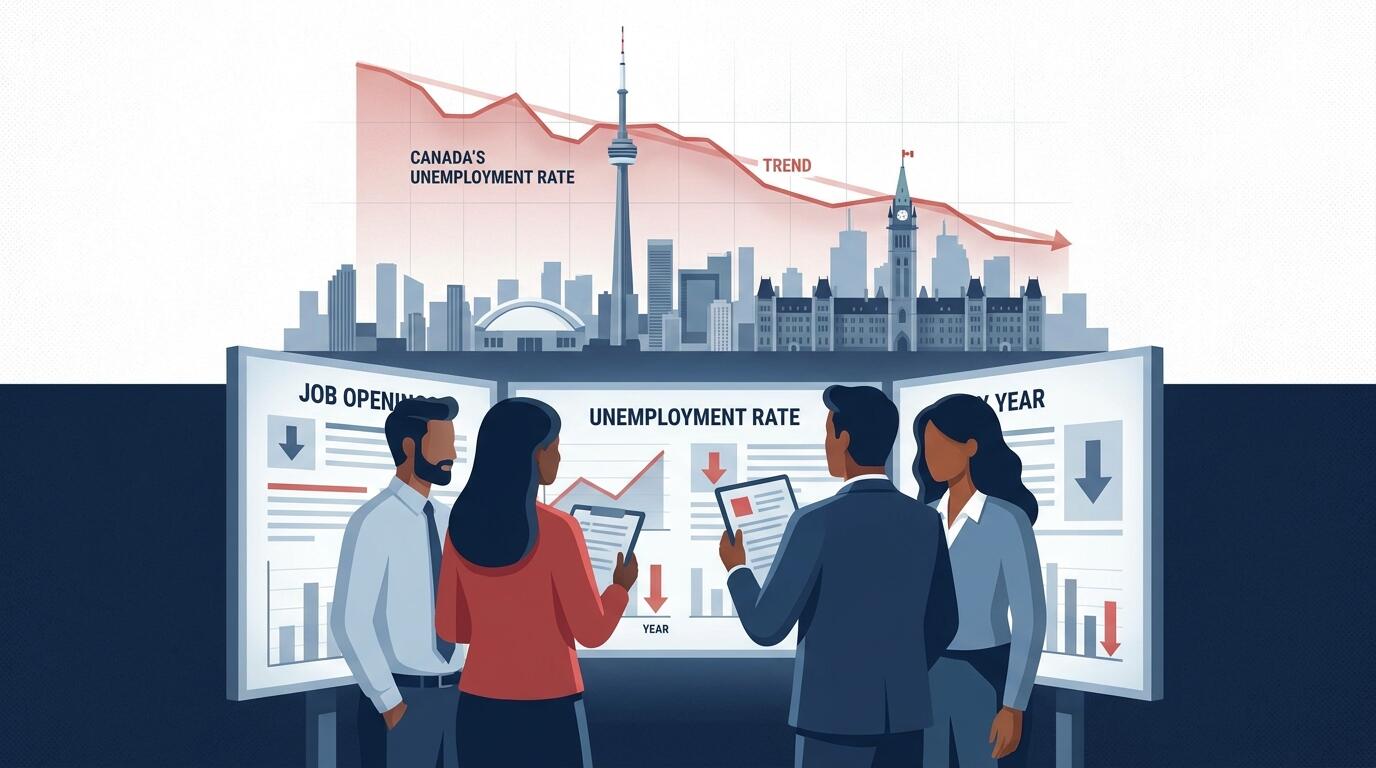
ALT: Canada unemployment rate rising explained in plain English for everyday readers
Canada's Unemployment Puzzle: Why More People Are Out of Work
Canada's jobless rate has been climbing steadily, and the headlines keep coming — but most of them assume you already understand the mechanics behind why unemployment rises in the first place. The truth is that Canada's unemployment rate is increasing due to a combination of forces that rarely get explained together in one place: slowing economic growth, a fast-growing labor force, the lingering effects of high interest rates, and a structural mismatch between the jobs being created and the skills workers currently hold.
This topic deserves a deeper look right now because the trend is accelerating, not easing. For anyone trying to understand what rising unemployment actually means — for the broader economy, for their industry, or for their own job security — the noise coming from financial media often creates more confusion than clarity. At Vega Brief, we consistently see readers arrive with the same frustration: the data exists, but the explanation doesn't. This article aims to fix that.
How Canada Got Here: The Current State of the Labor Market
Canada's labor market has undergone a significant transformation over the past few years. After a period of historically tight employment conditions following the pandemic — when job vacancies were plentiful and workers held unusual leverage — the market has shifted noticeably. The unemployment rate has been trending upward, reaching levels that reflect a meaningful cooling compared to that post-pandemic peak.
The unemployment rate is a measure of the percentage of people in the labor force who are actively looking for work but cannot find it. It's worth distinguishing this from broader economic slowdowns: unemployment doesn't just rise when people lose jobs. It also rises when more people enter the workforce — new graduates, immigrants, returning caregivers — but the economy doesn't generate enough new positions to absorb them all.
Canada has experienced both dynamics simultaneously. Population growth, driven heavily by immigration and international student arrivals, has expanded the labor force at a rapid pace. At the same time, the pace of job creation has slowed, partly because businesses facing higher borrowing costs have pulled back on hiring and expansion plans.
The Bank of Canada — Canada's central bank — raised interest rates aggressively starting in the early part of this decade to combat inflation. Those higher rates successfully brought inflation down, but they also had a cooling effect on economic activity more broadly. Consumer spending slowed. Businesses borrowed less. The housing sector, a major engine of economic activity in Canada, contracted sharply. All of this feeds into weaker demand for workers.
Reports tracking Canada's labor market have documented job losses in key sectors even while other areas — particularly government and healthcare — continued to add positions. The pattern that emerges is an uneven labor market: pockets of strength alongside broader softness, with the headline unemployment figure capturing the net result.
It's also worth noting that the composition of unemployment matters. A jobless rate that rises because more young people and recent immigrants are entering the workforce and searching for their first opportunity tells a different story than one driven by mass layoffs in a core industry. Canada's current situation contains elements of both, which is part of what makes it complicated to explain in a single headline.
The Root Causes: What's Actually Driving the Rise in Unemployment
Canada's unemployment rate keeps rising for several distinct but interconnected reasons. Breaking them down individually makes the overall picture much clearer.
Population Growth Is Outpacing Job Creation
Canada has welcomed record numbers of newcomers in recent years, a deliberate policy choice intended to address long-term demographic pressures like an aging workforce and a shrinking native-born population. But absorbing a large influx of workers into the labor market takes time, and the economy has not generated jobs at a pace that matches the inflow.
Labor force growth refers to the increase in the number of people either working or actively looking for work. When the labor force grows faster than job openings, unemployment rises even in the absence of layoffs. This is not a failure of any one policy — it is an arithmetic reality. Canada has been experiencing this dynamic in a pronounced way, with the labor force expanding while the economy simultaneously slows.
High Interest Rates Are Suppressing Business Activity
The Bank of Canada's rate-hiking cycle — designed to tame inflation — has had a significant dampening effect on hiring. When borrowing costs are elevated, businesses face higher costs for loans, credit lines, and mortgages. This leads to slower expansion, reduced capital investment, and more conservative hiring decisions.
Interest rate sensitivity describes how economic activity responds to changes in borrowing costs. Canada's economy is particularly sensitive to interest rate changes because of its high level of household debt and the prevalence of variable-rate mortgages. When rates rise, Canadian households quickly feel the pinch in their monthly payments, which leaves less money for spending. Less consumer spending means lower revenues for businesses, which in turn means fewer jobs. The connection between central bank rate decisions and everyday financial pressures runs through the economy in ways that play out slowly but consequentially.
Structural Mismatches in the Job Market
Not all unemployment is the same. Structural unemployment occurs when the skills workers have don't match the skills employers need, or when available jobs are in different geographic locations than unemployed workers. Canada is experiencing a meaningful degree of structural unemployment alongside its cyclical slowdown.
Technology is reshaping which roles employers want to fill. Industries tied to resource extraction, traditional retail, and manufacturing have shed positions, while demand for roles in technology, healthcare, and specialized trades has grown. Workers displaced from declining sectors can't always pivot quickly to growth areas, and the training pathways to do so take time.
There's also a geographic dimension. Job growth in Canada is not evenly distributed. Certain urban centers continue to generate opportunities while rural communities and smaller cities experience more prolonged weakness. A worker in a region with limited opportunities may face unemployment not because jobs don't exist in the country but because none exist within reach.
Global Headwinds Adding Pressure
Canada's economy is deeply integrated with global trade, and particularly with the United States, its largest trading partner. Any slowdown in U.S. economic activity reverberates through Canadian exports, manufacturing, and business confidence. Trade policy uncertainty — including the threat or reality of tariffs — further complicates the picture for Canadian exporters and the workers they employ.
The global investment environment also matters. AI-driven investment trends are propping up growth in certain economies, but those benefits are not flowing equally to every sector or country. Canada's economy, still heavily weighted toward resources and real estate, has not fully captured the tailwinds that technology investment is generating elsewhere.
Evidence and Competing Explanations: How Analysts See It Differently
Economists and labor market analysts broadly agree on the facts — job growth is slowing, labor force participation is rising, and the unemployment rate is higher than it was during the post-pandemic boom. Where they diverge is on what it all means and what should be done.
Some analysts argue that Canada's rising jobless rate is primarily a cyclical problem — a natural consequence of tighter monetary policy that will resolve itself once interest rates come down sufficiently. Under this view, the Bank of Canada's rate cuts (which began after the inflation battle showed results) will gradually restore business confidence, stimulate borrowing and investment, and bring hiring back to a healthier pace. The unemployment rise is painful but temporary.
Other analysts argue that structural issues are the dominant force, and that lower interest rates alone won't solve them. If the mismatch between worker skills and employer needs is deep — and if immigration-driven labor force growth continues at its current pace — then even a more accommodating monetary policy environment may not produce the job growth needed to bring unemployment back down quickly. This view implies that Canada needs not just rate cuts but also targeted investments in job training, workforce integration programs, and economic diversification.
A third perspective focuses on measurement limitations. The official unemployment rate captures only those who are actively looking for work and can't find it. It doesn't capture people who have stopped searching, those working part-time who want full-time work, or workers in precarious contract arrangements that provide little stability. Critics argue that the headline number understates the true degree of labor market stress.
Perspective — Strengths — Trade-offs — Best Fit
Cyclical slowdown view — Explains the timing and links to rate hikes logically — May underestimate structural mismatches — Useful for understanding short-term trend
Structural mismatch view — Captures technology shifts and immigration dynamics — Harder to act on quickly; requires long-term policy — Useful for long-term policy planning
Measurement critique — Highlights hidden stress not shown in headline data — Less actionable without clearer alternative metrics — Useful for assessing real-world worker experience
ALT: Chart illustrating rising Canada unemployment rate driven by structural factors, interest rates, and labor force growth trends
The data that does exist from labor market reporting paints a picture of uneven distribution. Younger workers and recent immigrants face disproportionately high jobless rates compared to prime-age native-born workers. The Financial Post has documented specific periods in which the economy shed net jobs even as the headline labor force expanded, creating the arithmetic condition where unemployment rises despite ongoing hiring in some sectors.
What Comes Next and What It Means for You
Canada's unemployment rate is unlikely to reverse sharply in the near term. The conditions that produced the rise — high borrowing costs, rapid labor force growth, global uncertainty, and structural mismatches — don't unwind overnight. Rate cuts by the Bank of Canada can provide relief, but their effects take months to percolate through to business hiring decisions and consumer confidence.
The most realistic trajectory, based on current dynamics, is a gradual stabilization followed by a slow decline as monetary easing takes hold and labor force growth moderates. Some analysts expect the labor market to find a new floor before any meaningful recovery in hiring momentum.
For everyday readers, a few practical implications are worth keeping in mind. A rising unemployment rate tends to shift bargaining power from workers toward employers. This doesn't mean job losses are inevitable for any individual, but it does mean that workers may face more competition for openings, slower wage growth, and less leverage in negotiating terms. Industries that rely on discretionary consumer spending are typically more exposed than sectors tied to essential services.
There's also a broader economic feedback loop to understand. Higher unemployment tends to reduce consumer confidence and spending, which can further slow business revenues and hiring — a dynamic that economists call a negative feedback loop. Policy interventions, including fiscal measures (government spending programs) and monetary easing, are typically deployed to break this cycle before it deepens. Canada's government and central bank are both navigating these pressures simultaneously, which is why the policy response in the months ahead will be closely watched.
For workers in sectors that are more exposed — retail, construction, parts of finance, and export-dependent manufacturing — staying informed about how these macro forces are moving is genuinely useful, not just as intellectual curiosity but as practical career awareness.
Q1: How does Canada's population growth cause unemployment to rise?
When Canada's population grows faster than the economy creates jobs, more people compete for a limited number of openings — and some inevitably can't find work. Canada has experienced record-level immigration and international student arrivals in recent years. Even when the economy is adding jobs in absolute terms, if the labor force grows faster, the unemployment rate still rises. Statistics Canada, the federal agency that tracks labor data, measures this by comparing job seekers to available positions across the full workforce.
Q2: Is the Bank of Canada's rate policy responsible for rising unemployment?
The Bank of Canada's interest rate increases — designed to bring inflation under control — contributed to the rise in unemployment by making borrowing more expensive for businesses and consumers. Higher rates reduce spending and investment, which slows hiring. The Bank of Canada has since begun cutting rates, a signal that it is shifting focus toward supporting growth and employment. However, the full effect of rate cuts on the labor market takes time to materialize, which is why unemployment can continue rising even after a central bank pivots its policy direction.
Q3: How long does it typically take for unemployment to come down after interest rates fall?
There is no fixed timeline, but economic research generally suggests that the labor market responds to monetary policy changes with a lag of several months to over a year. Businesses need to see consistent evidence that borrowing costs are falling and that consumer demand is recovering before committing to new hires. In Canada's current situation, the structural elements — skills mismatches and elevated labor force growth — could extend that adjustment period beyond what a purely cyclical recovery would require.
Wrapping Up
Canada's rising unemployment rate is the product of multiple overlapping forces, not a single cause. Three core points stand out from this analysis.
First, labor force growth driven by immigration has outpaced job creation, creating upward pressure on unemployment even when hiring continues in some sectors. Second, the Bank of Canada's rate-hiking cycle dampened economic activity across the board, reducing business hiring and consumer spending in ways that are only now beginning to unwind. Third, structural mismatches — between worker skills and employer needs, and between geographic concentrations of jobs and workers — mean that lower interest rates alone may not be sufficient to fully reverse the trend.
The practical takeaway is that understanding these dynamics helps you read future headlines more critically. When a jobs report comes out, the unemployment rate tells only part of the story. Labor force participation, job quality, sector distribution, and wage trends all add important context that the headline number leaves out.
For anyone navigating this environment as a worker, a student, or simply a curious reader trying to make sense of economic news, the most useful habit is continuing to ask what's behind the number — not just what the number is.
If you want to stay on top of Canada's labor market trends and understand the economic forces shaping your world, head over to Vega Brief — where every financial headline gets the plain-English explanation it deserves, backed by real sources and free of jargon.
References & Further Reading
Financial Post. "Canada's unemployment rate rises as economy sheds jobs".
https://financialpost.com/news/economy/canada-unemployment-rate-rises-economy-sheds-jobs
RSM Canada / Real Economy. "Canada's unemployment rate rises to 5.7% as hiring slows".
https://realeconomy.rsmus.com/canadas-unemployment-rate-rises-to-5-7-as-hiring-slows/
Statistics Canada. Labor force survey and employment data.
https://www.statcan.gc.ca
For educational purposes only. Not investment advice. We do not recommend any stock, fund, broker or trading platform. Headlines are sourced from Google News · Business; every story links to the original publishers.